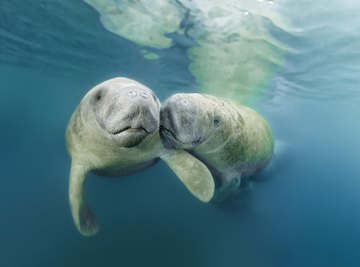
Manatees are large sea mammals that are sometimes nicknamed “sea cows.” These gentle creatures ply warm waters in different parts of the world, depending on their species. The three species of manatee are the West Indian, West African, and Amazonian species. These large, gentle creatures are popular, but care is needed to protect them.
TL;DR (Too Long; Didn't Read)
Three species of manatee exist today, and two of them can venture between salt and fresh water in the ocean near coastlines. One species, the Amazonian manatee, lives only in freshwater.
Manatee Classification of Species
Manatees are mammals. Manatee classification falls under Class Mammalia, Order Sirenia, Family Trichechidae, Genus Trichechus. Further manatee classification falls under the species level. Three species of manatee still exist today: The West Indian manatee, or Trichechus manatus; the Amazon manatee, or Trichechus inunguis; and the West African manatee, or Trichechus senegalensis. These manatee classifications distinguish manatees from their closer relative, another member of Order Sirenia called the dugong (Dugong dugon). While dugongs are part of the same order as manatees, they are not considered actual manatees.
Intriguing Manatee Facts
Manatees belong to their own order, Sirenia. While some people call them “sea cows,” they are not related to cows. Their closest living relative is the elephant. In fact, manatees share some remnant similarities to those distant elephant cousins. The few, small toenails at the end of their flippers resemble the toenails on an elephant. Their upper lips have an overhang that is in some ways a vestigial trunk, like an elephant’s. It is also used to grab food.
Manatees are large – some can weigh as much as 1,200 pounds, although Amazonian manatees are smaller. They have lungs that extend beneath the spines on their backs and that help with floatation; their rib muscles squeeze the lung volume to make manatees denser than their surrounding water. Manatees will adjust this density to rise to the surface, breathe and lower back down. Manatees can stay under the water for about 20 minutes before they need to break the surface to breathe. Their lungs are highly efficient, replacing as much as 90 percent of the air they breathe when they inhale during that surface break.
The eyes of manatees may be small, but they can see well underwater. In fact they can see colors and shapes. Their eyes posses a special protective membrane.
The teeth of manatees keep growing throughout their lives. This is because the plants they eat also bring in grit and sand, which erodes their teeth. So to replace those worn teeth, new molars emerge in the backs of their mouths. These teeth are never used to attack. They only serve to grind up plant food.
Manatees are incredibly docile animals. They are primarily vegetarian and have abundant food supplies, so they have no need to hunt. They are so large that as adults, they have no natural predators. In fact, even alligators will not mess with an adult manatee. A manatee can just push an alligator aside with a bump! Despite this, very young or weak manatees may be taken by crocodiles, alligators or sharks.
While generally slow-moving, a manatee can in fact swim in bursts of up to 15 to 21 miles an hour, propelled by their powerful tails.
Manatees can eat as much as 10 percent of their body weight every day, or over 100 pounds. The main food sources for manatees are underwater grasses, algae, weeds, water hyacinths and mangroves.
The brains of manatees are smooth compared to human brains, and the size of a manatee’s brain is small in comparison to its body. They also possess only six vertebrae versus the typical seven in most mammals. The metabolism of manatees is slow, but because their bodies are so large, they must continually eat to maintain body heat.
Manatees tend to reside alone or in small groups. Many males may pursue a female. Upon mating, the female carries her baby for approximately 12 months. After the baby is born underwater, the mother will nurse it for about 18 months. Babies can swim on their own within an hour of birth. Manatees reach maturity at approximately five years of age and can live as long as 60 years in the wild. West African manatees can live at least to 39 years old, although more research is needed for this species.
Manatee Habitats in the World
Manatees are warm-water animals. The three different species of manatee live in three different general areas. They may reside in oceans, inlets, slow rivers, lagoons, estuaries or bays. They tend to remain near to coasts.
The West Indian manatee is famous in North America. The West Indian manatee habitat in summer includes the Gulf of Mexico, the Caribbean and sometimes even extends to the coast of New England! But once the weather turns cold and the water along with it, West Indian manatees will congregate off the coast of Florida. Occasionally manatees will even seek out the warm water around power plant outflows. Most of the time, West Indian and West African manatees can move back and forth among fresh and salt water. Their kidneys are able to keep their salt concentrations in check. West Indian manatees must remain in warm water, for despite their great size, they possess little body fat. Manatees will start to move once the water dips to around 68 degrees Fahrenheit. West Indian manatees in the ocean like to stay close to land, and they can reside in clear, fresh, brackish or salty water.
The less famous Amazonian manatees live only in fresh water. They are the smallest of the manatee species, and they prefer the rivers in South America. especially at the mouth of the Amazon River in Brazil, which is a primary manatee habitat for this species. Amazon headwaters in the countries of Colombia, Peru, Guyana and Ecuador also host the Amazonian manatee, as does the Orinoco basin. Amazon manatees tend to eat a lot of food during the west season, when vegetation is abundant. They store fat for the dry months when they must fast. During the dry months, these manatees leave their creeks and inlets to head for larger rivers, where they meet with other manatees. The low birth rate and long young-rearing time adds to the challenge of ensuring sustainable populations of the Amazonian manatee.
The West African manatee habitat extends along the coasts and tributaries of 21 countries in West Africa. They can be found in rainforest lagoons or even in rivers along the Sahara Desert, as well as around Atlantic islands. Some West African manatees venture as far as 2,000 miles inland in Mali and Chad. While mostly herbivorous, the West African manatee distinguishes itself from its cousins by its taste for mollusks such as clams and mussels, and fish. The West African manatee is the most endangered species, and little is known about them compared to the West Indian and Amazonian manatees.
Challenges for Manatees in the Water
Manatees are considered threatened species. While manatees have no natural predators, the influence of humans endangers them. Boats strike many manatees in the water. The relatively slow speed of manatees makes it hard for them to avoid such encounters. Some manatees are still sought for their meat, bones and oil. Illegal harpoon hunting particularly threatens the Amazonian manatee. Unfortunately, manatees suffer when caught in fishing nets, particularly in West Africa and the Amazon region. Another threat to West African manatees is being caught behind dams. Habitat destruction also plagues the West African manatee. The huge Stellar’s sea cow was another type of manatee that went extinct in the late 18thcentury.
Efforts to save current manatee species are underway but face escalating challenges due to pollution and boats. Additionally, the loss of their favored sea grass threatens manatees. Pollution from human factories and agriculture can affect the quality of the water in which manatees make their home. This can lead to red-tide blooms, algae that release nerve toxins that can paralyze and suffocate manatees. Swimmers and divers that encounter manatees in the water may mean well, but their interaction with manatees threatens to change the animals' behavior, which can make them less safe. The best way to treat manatees in the water is to watch from a respectful distance, and work to protect their habitat while reducing risks.
References
- National Geographic: Manatees
- Smithsonian Magazine: 14 Fun Facts About Manatees
- World Wildlife Fund: Amazon Manatee
- World Wildlife Fund Brasil: The Amazonian Manatee: A Vegetarian Singer
- PBS News Hour: 8 Things You Didn’t Know About Manatees
- The National Wildlife Federation: Making Sense of Manatees
- San Diego Zoo: Manatee
- National Geographic: African Manatee: Freshwater Species of the Week
About the Author
J. Dianne Dotson is a science writer with a degree in zoology/ecology and evolutionary biology. She spent nine years working in laboratory and clinical research. A lifelong writer, Dianne is also a content manager and science fiction and fantasy novelist. Dianne features science as well as writing topics on her website, jdiannedotson.com.