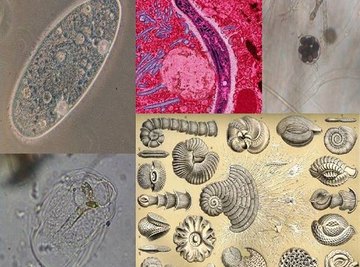
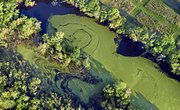
Protists are organisms in the Kingdom Protista. They are usually microscopic and made up of only one protist cell, which means that they are unicellular. Protists are eukaryotic; they have a nucleus and membrane-bound organelles that set them apart from organisms like bacteria and archaea.
It is thought that the plant, animal and fungi kingdoms are monophyletic, which means they have a single ancestor leading to the evolution of all individuals in the kingdom.
The idea that all plants could have evolved from one plant is an example of this theory. On the other hand, protists did not arise from a single ancestor. This kingdom is a grouping of eukaryotic animals, plants or fungi that don't belong in any of the other kingdoms.
Some individuals in this kingdom are as unrelated as humans are to fish! Some protists use photosynthesis to collect energy from the sun, while others find food from an outside source. These protists are known as heterotrophs.
Now that we know how protists are structured and how they get food, how do they reproduce?
Asexual Binary Fission
Asexual reproduction means that only one parent organism is necessary for producing offspring. In most cases, the offspring are copies of the parent. Asexual binary fission in protists is one major mechanism of reproduction. A single-celled protist's body is separated into two parts, or halves.
After this process, there is no longer a "parental" body, but a pair of offspring. These offspring are called daughter nuclei. This process could take anywhere from a few hours to many days depending on the environment and outside factors.
Some algal unicellular protests undergo a similar process known as fragmentation. In binary fission and fragmentation, the nuclear material is fragmented before the cytoplasm (material filling the cell) divides into the offspring individuals.
Multiple Fission
Another type of reproduction in protists is multiple fission. The protist's nucleus divides over and over again to create multiple daughter nuclei.
These nuclei will then go on to provide genetic material for each of the offspring. Through this process, four individuals up to hundreds of individual offspring could be produced relatively quickly.
Budding is the most common type of multiple fission in protists. The daughter nucleus is created and splits from the parent, taking some of the cytoplasm of the protist cell with it. In other parasitic protists, sporozoites are created through the zygote dividing again and again and again.
Multicellular Algal Protists
While most protists are unicellular, there are exceptions to the rule. Some of these protists can reproduce using asexual spores, which can also be produced through many fissions.
The spores later turn into an amoeba-like cell that can pair up with another spore to create a zygote.
Sexual Protist Reproduction
Some unicellular protists even reproduce sexually, and are able to create gametes, or sex cells, that can fuse together to form a new organism in a process known as syngamy. Conjugation is another type of sexual reproduction that mainly only occurs in ciliates.
In this process, nuclei from gametes come together and fuse to create a zygotic nucleus.
Life Cycles of Protists
Protists can have life cycles that vary from simple to complex. Some may have one periodic binary fission, while others have asexual and sexual phases to successfully complete reproduction. Some algal protists even undergo a process similar to a mammal's hibernation!
In periods of low food or cold temperatures, the organism is preserved by entering a dormant stage in the life cycle. Life cycles may also involve multiple hosts, as well as a carrier that brings the parasite to the next host.
References
About the Author
Lindsey is finishing her M.S. Environmental Conservation degree at the University of Wisconsin Madison. She spent four summers communicating science in Denali National Park and has continued to search for ways to communicate science in and outside of work. In her free time, she enjoys hiking, backpacking, making music, and sitting around the campfire.
Photo Credits
Wikimedia Commons, Biomedia Associates, Peter Parks/Oxford Scientific Films, David Asai/Amy Walanski/Purdue University, CDC/Dr. V. R. Dowell, Jr.