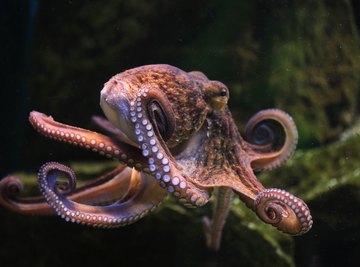

All living things require oxygen. Oxygen is found in the atmosphere and in water. Water creatures need to filter the oxygen out of the water and then discard the water so that they don’t drown. An octopus breathes in the same manner that all fish breathe, which is through gills. The octopus gills are located inside the mantle cavity and exit to the outside of the body. The oxygen requirements of octopus are greater than those required by other mollusks and fish. Octopuses have three hearts, two of which pump blood across the two gills, where oxygen exchange takes place.
The Mouth of an Octopus
The beak-like mouth of an octopus is located on the mantel cavity at the back of the bulbous head of the octopus, surrounded by the eight legs. The mouth is the entryway to the mantle cavity which has gills inside of it. The octopus uses these gills to breathe. Water is brought into the octopus mouth and is then passed through the gills back into the body of water. As the water is pushed over the surface of the gills, oxygen is picked up by the blood in the capillaries of the gills.
The Gills of an Octopus
The gills are made up of many feathery filaments. These filaments allow for a larger surface area across which the oxygenated water passes over. This large surface area allows the octopus to pick up more oxygen per breath.
The Exchange of Oxygen
The oxygen is picked up in the capillaries by the process of a counter current exchange. Oxygen will be picked up in the capillaries as long as the level of oxygen is lower in the blood than it is in the water. When counter current exchange is used, the oxygen level will always be lower in the blood than in the water, allowing for continuous exchange of oxygen between the water and blood. This means that blood travels in an opposite direction in the gills than the direction that the water is traveling. This allows for maximum oxygen exchange per breath. Due to the muscular system of the octopus that contracts the mantle cavity, forcing oxygenated water across the filaments of the gills, the octopus is able to attain the 11 percent oxygen saturation level in its blood that it requires. Most fish and mollusks attain an average of 3 percent oxygen saturation.
The Hearts of an Octopus
Two of the three hearts of an octopus pump blood through the gills. The oxygenated blood that leaves the gills returns to the third heart to be pumped back through the rest of the body. The oxygen is carried in the protein hemocyanin instead of the red blood cells commonly found in mammals. Hemocyanin is dissolved in the blood's plasma, causing the blood to be a blue color.
About the Author
Christy Flora has been writing professionally for more than fifteen years after winning her first awards for writing in the early 1980's. With a degree in Education, specializing in Organizational Leadership, Flora is an experienced, and published, author and editor. As a writer Flora has worked as an instructional designer spanning the genres of informational, educational and technical.