
All About the Tiger Class
Tigers are in the cat family. Tigers are known for their reddish-orange coats that have dark, rich brown to black stripes. Tigers are also known for their beautiful amber-gold colored eyes. There are also approximately 200 recognized white tigers with blue eyes and 30 golden tabby tigers in the world. These particular tigers only exist in captivity.
A tiger's teeth are approximately 3 to 4 inches in length. They have the longest canine teeth in comparison to any other land-based mammal in the world. Tigers have retractable claws like most cats; however, the cheetah does not. The tiger's retractable claw ability keeps their claws extensively razor-sharp to grasp things and for when they are in battle. Tigers generally weigh up to about 700 pounds. The largest tiger ever recorded was a male Amur that weighed 1,025 pounds.
Tigers are beautiful, exquisite creatures in addition to the lion, the puma, the leopard, the ocelot, the jaguar, the cheetah and the mangy tom, which are all related to the tiger family as well.
Where Do Tigers Live?
Tigers consist of six major species: the Bengal (Indian) tiger, the Indochinese tiger, the Sumatran tiger, the South China tiger, the Malayan tiger and Siberian (Amur) tiger. Tigers live in the wild in many regions throughout the globe, however, most can be found in Nepal, Tibet, India, South China, Sumatra in Indonesia, Siberia, and South East Asia. All of the present-day tigers descended from the tigers that were originally in South Central China.
How Do Tigers Sleep?

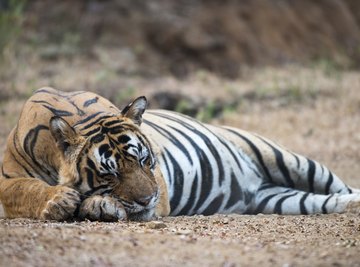
Tigers sleep a very long time, typically about 18 to 20 hours a day. Tigers sleep on rocks, in grass in their wild habitat, next to their prey or wherever they feel the need to rest. Tigers typically do not spend more energy than what's needed, because if they spend more energy, they require more food. Tigers usually sleep after they make a kill and eat. Because a tiger can feed off of one large prey for a number of days, a tiger generally eats as much as he can and then rests or sleeps near the prey until ready to gorge again. Tigers rest by their prey to keep other predators from taking their food. Once a tiger eats all the prey, the tiger rests and sleeps. When he awakens, the tiger begins his search again for more food.
About the Author
Claudette Pendleton runs a virtual company from home. She performs quality work for several companies. Her areas of expertise include transcription, elementary essay assessment, title editing, freelance writing and editing as well as website user testing and real estate. Claudette enjoys the variety of her work and has been working in these areas for over 7 years.