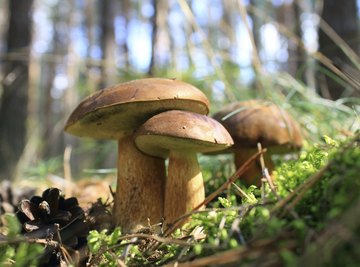

Humans have a mixed relationship with fungi. Fungi such as truffles provide a culinary treat, whereas the different type of fungus that causes athlete's foot gives nothing but discomfort. Some types of fungi have the ability to break down trees into rich soil but will also destroy the wood in your home. The kingdom of fungi includes thousands of species, most of which can reproduce sexually, asexually, or both – depending on the circumstances. The reproductive world of fungi ranges from bursting spores to fruiting bodies.
Fungal Reproduction Basics
Although there are many different types of fungi, with a wide range of appearances, most have similar vegetative structures. The main body of a fungi is made up of a network of thread-like structures called hyphae. This body, a mass of hyphae, is the vegetative stage of fungi and is called the mycelium, according to Georgia Tech Biological Sciences. For terrestrial fungi, the mycelium grows underground and can extend for miles.
In many fungi, the hyphae play an important role in the reproductive stage of the organism. For example, some fungi produce a fruiting body formed from hyphae that stick up out of the ground.
Asexual Spores of Fungi
During asexual reproduction, some hyphae become spore-producing bodies called sporangia or conidia. The group of fungi known as Zygomycota develop sporangia within a sac. Sporangia can be unicellular or multicellular, and look like a sac or a capsule.
This sac or capsule then bursts to release the spores. Once the spores land on a suitable habitat, they germinate a new hypha that grows into a mycelium.
In the fungi phyla Ascomycota and Basidiomycota, spores called conidia are not held within a sac. Once the spores disperse, they will germinate and form a new mycelium. The phylum Ascomycota includes fungi such as the one responsible for athlete's foot; the phylum Basidiomycota includes fungi such as mushrooms.
Sexual Reproduction of Fungi
Some types of fungi that reproduce asexually can also reproduce sexually, according to the National Center for Biotechnology Information. In sexual reproduction, the hyphae of individual fungi meet and join together to become what is called a gametangia in a process known as plasmogamy. Within the gametangia, the nuclei from the cells of the two individuals fuse.
This process – karyogamy – combines and mixes up the DNA from the two individuals. Karyogamy produces a spore that has double the normal number of chromosomes, and sexual reproduction of fungi results in the production of two mating types rather than two sexes. During meiosis, which follows karyogamy, this diploid spore halves itself to create two spores each with the normal number of chromosomes.
Fungi in the phyla Zygomycota, Ascomycota and Basidiomycota can each reproduce sexually. The difference is the structure the spores form in. Basidiomycota form fruiting bodies called mushrooms or basidius; Ascomycota have sacs called ascus; and Zygomycota produce zygospore.
Variation Among Fungi
Although some groups of fungi reproduce both sexually and asexually through spores, other groups only reproduce asexually. This includes some yeasts that reproduce through cell division and other fungi that reproduce through fragmentation, where a piece of hyphae breaks off to form a new mycelium.
Lichens, a symbiotic combination of fungi and algae, also reproduce asexually. During reproduction, pieces of hyphae join with a piece of algae in a structure known as a soredia. The soredia then disperse from the parent lichen to form a new lichen elsewhere.
Although slime molds are classified as protists, their reproductive strategy is similar to fungi in that spores are formed in fruiting bodies. These slime molds may have been the evolutionary precursor to the fungi kingdom, according to evolutionary biologists.
References
About the Author
Based in Portland, Ore., Tammie Painter has been writing garden, fitness, science and travel articles since 2008. Her articles have appeared in magazines such as "Herb Companion" and "Northwest Travel" and she is the author of six books. Painter earned her Bachelor of Science in biology from Portland State University.
Photo Credits
Juliasv/iStock/Getty Images