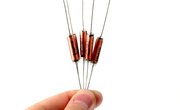
Diodes are semiconductor devices that effectively block current in one direction while allowing current flow in the other. An ideal diode, therefore, acts like a switch that is open in one direction and closed in the other. Diodes are enclosed in cases such as glass or plastic that are marked with a band to indicate the cathode side. Current flow from the anode to cathode means the diode is forward-biased, while current flow from the cathode to anode means the diode is reverse-biased.
Construction
Diodes are formed from semiconductors such as silicon or germanium that are doped to form what is known as a PN junction. PN junctions are created from a combination of P-type and N-type semiconductors. P stands for positive, and N for negative. Semiconductors have holes or positive charges, and free electrons or negative charges.
P and N Types
A semiconductor that has been doped to form a P-type has holes as the majority carriers, and electrons are minority carriers. An applied voltage causes the electrons to move to the left and the holes to the right, and the holes recombine with free electrons from the external circuit. The electrons are so few in number that their effect is negligible, and so only the movement of the holes is considered. P-types have excess positive charge.
A semiconductor that has been doped to form an N-type has free electrons as the majority carriers, and holes as the minority carriers. An applied voltage causes the free electrons to move to the left, and the holes to the right. These holes are filled in by electrons from an external circuit. The holes are so few in number that their effect is negligible, and so only the flow of the free electrons is considered. N-types have excess negative charge.
Features
A diode is symbolized by an arrow that indicates the direction current flow is allowed. It is called forward-biased when the current is flowing this way. The arrow has a bar to indicate that the current is blocked when going in the opposite direction. A diode with current flow in the wrong direction is called reverse-biased. In real life, reverse-biased diodes will block current flow, but will finally allow some when there is too much the wrong way. When this happens, normal diodes will self-destruct.
Special Types
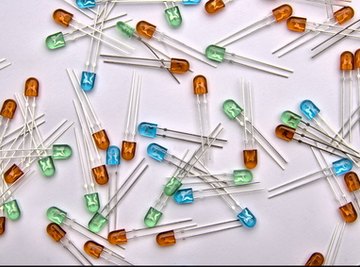
LEDs are light emitting diodes specifically constructed to emanate light. Zener diodes are made to conduct when they are reverse-biased, instead of becoming destroyed. Varistors behave like back-to-back zener diodes, and can handle up to 1,000 volts. Varactors function like voltage varying capacitors.
Uses
Diodes are used in numerous ways. Some of them are changing AC current to DC current, by removing part of the signal. In this capacity, they are known as rectifiers. They function as electrical switches, and are useful in surge protectors because they can prevent voltage spikes. They are used in performing digital logic. They are also used to create power supplies and voltage doublers.
LEDS are used as sensors, as well as for illumination in lighting devices and lasers. Zener diodes function as voltage regulators, varactors are used in electronic tuning and varistors are used to suppress transients in AC lines.
Diodes are the basis of transistors and op-amps.
About the Author
Kim Lewis is a professional programmer and web developer. She has been a technical writer for more than 10 years and has written articles for businesses and the federal government. Lewis holds a Bachelor of Science, and occasionally teaches classes on how to program for the Internet.
Photo Credits
LED image by URIO from Fotolia.com