Try to imagine a world without the Internet. That's at least a little uncomfortable, right? Now, remove mobile devices of any kind from the equation, along with digital cameras and GPS technology.
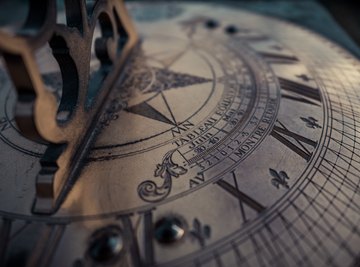
When you go even further and eject wrist watches and wall clocks from the mix, things start to feel almost panicky in a hurry. It's hard to believe today that until the early 1800s, the sundial had been humankind's main way of keeping time for thousands of years!
That stuff is all prep for the real question, though: What if you could not tell time? At all? As in, what if life lacked any context for pinning down the whole notion of "when" in anything resembling the immediate sense? (A modern Earthling is ill-equipped to even confront this question; it's probably not possible for you to purge your mind of the whole concept of seconds, minutes and hours, and of the predictability the whole scheme of structured time offers.)
At some point in human cognitive evolution, your ancestors developed the ability to associate routine, or at least regular, astronomical phenomena with the passing of fixed amounts of "time," whatever and however they conceived of this quantity (which even today eludes proper description even if there is a way to account for it in math and physics).
Examples are the rising and setting of the sun, stars and moon each day, the phases of the moon and the way the sky cycles through a precise and predictable transformation every time the Earth completes another spin around its axis of rotation (a "day") or trip around the sun (a "year").
Enter the Sundial: the Basics
At a given stage in human or pre-human evolution, the creation of elaborate tools allowed for your ancestors to accelerate their effective separation from other apes. Hominid brains became sophisticated enough to appreciate the temporal relationship between physical inevitabilities in their environment and biological realities they needed to be cognizant of, such as the fact that it is easier to sleep "at night"(that is, in darkness) but also the fact that certain dangerous predators go on the prowl when it's dark.
What is a sundial? Formally, it is a chronometer (i.e., a timepiece) that uses the shade produced by sunlight falling on a vertical rod to show local time. For reasons you'll see shortly, the rod, called a gnomon, must be positioned parallel to Earth's axis of rotation and point toward a position in the sky that corresponds to due north, or the celestial north pole (CNP).
Therefore, at any given geographical latitude, the rod must be tilted at an angle to the horizon (that is, the horizontal) that is identical to the magnitude of that latitude.
For example, someone building a sundial at latitude 40° in Boulder, Colorado, in the United States, would aim the gnomon 40 degrees above the middle of the northern horizon, just under halfway to the point directly overhead (the zenith). As you may know, since there are 360 degrees in a circle, a half-circle like the sky covers 180 degrees; this means the angular distance from any horizon to the zenith is half of this, or 90 degrees.
- Note: The directions in this article are aimed at readers in the Northern Hemisphere. Others should reverse north-south directions as situations calling for this arise.
Learning About Sundials
Having a proper handle on basic sundial facts requires memorizing the names of a few non-moving parts, but it is hoped that you will approach this thinking like an astronomer and gaining an appreciate for not just a high-quality sundial's amazing craftsmanship, but also the science that has allowed this class of devices to perform their single, endless job for thousands of years of human history.
You'll be exposed to all manner of interesting new terms as you read through this article, and you'll even be poised to build your own sundial – be it humble or elaborate – by the time you're through. But the most important thing for you to try to focus your thinking on here is the relationships between the ecliptic, the celestial equator, and the celestial poles.
You see, when learning about sundials, you're not really learning how to make a quaint, if fascinating, tool that is no longer needed thanks to colossal and ongoing jumps in human technology. You're leaning a great deal about the very framework of astronomy – how objects are located and labeled, and how the heavenly cycles you see and take for granted were integrated into even the earliest sundials from 1500 BCE or so.
The Celestial Equator
Original creators of the sundial recognized the relationship between simple geometry and the behavior, or specifically the apparent behavior, of objects in the sky. The distinction is important, because for purposes of a sundial, the Earth is treated as fixed, with other things "rising" and "setting" and "crossing the sky" – descriptions that only make sense from the reference point of an Earth observer, and which account for why the ancients did understandably think that everything in the cosmos literally revolves around Earth.
The easiest way to imagine the system used to map objects in the sky is to take the one used here on Earth (latitude and longitude) and picture the imaginary lines being projected onto an imaginary sphere (actually a hemisphere, since you can see only half of it) in the sky. A plane drawn through the middle of the Earth through its equator intersects this celestial sphere in a circle, which presents as a line called the celestial equator.
The Ecliptic
Meanwhile, another circular line in the sky is formed by the extension of the plane of Earth's revolution around the sun. This imaginary line is called the ecliptic, and represents the apparent 360-degree path of the sun through each year with respect to the distant background stars. These stars appear motionless in comparison to the sun and planets, because one way we measure the movement of the latter is treating the former as a "fixed" reference frame.
- During a car trip, faraway things like clouds and distant mountains appear to be moving with you, even as you quickly put horizontal distance between yourself and the trees, cows and other objects that are far closer to the roadway. This is true even though those mountains, like distant stars, are in fact shifting with respect to your own position; they're just doing so much, much more slowly.
Because Earth's axis of rotation is tilted by 23.4° from its plane of revolution around the sun, the ecliptic and the celestial equator are offset (tilted) by this amount. But they meet at two points, like intersecting hula hoops of the same size. The sun follows the celestial equator on these two days everywhere on Earth, on the vernal equinox (transition from winter to spring in the Northern Hemisphere) and transition from summer to fall (autumnal equinox).
- The daily rotation of the Earth and the fact that no stars are visible when the sun itself is makes visualization of the ecliptic difficult for a newcomer. Be sure to consult diagrams frequently as you read about sundials!
Other Standard Astronomical Terms
On Earth, lines of latitude are parallel to each other all the way from the equator to both poles. The lines in the sky corresponding to latitude lines are called lines of declination, and establish north-south dimensional location.
Lines of longitude, on the other hand, are also called meridians on Earth. These can be imagined as radiating outward from the two points formed by the celestial poles and meeting again at the opposite pole, though no Earth viewer can see both poles at once. The line passing from directly north on the horizon through the zenith and toward due south on the opposite horizon is known as "the" meridian in celestial lingo.
- Because the meridian separates the celestial sphere into eastern and western halves, it plays a critical role in sundial design and positioning.
When identifying the east-west position in the sky of a celestial object, this part of the coordinate is known as right ascension.
Sundial History
You have surely noticed that when the sun is close to the horizon (early morning or late afternoon), shadows are longer than they are when the sun is more directly above you. Yet the sun is crossing the sky at the same speed all the time, even if the shadows are changing size and shape at different speeds.
This whim of geometry inspired the first sundials, as their inventors realized that "time" could be divided reliably not just into days but portions of a day. The improved ease of scheduling life activities under such a system are obvious.
The earliest sundials are believed to date back to Egypt, circa 1500 BCE. Some of these were actually pocket-sized and could be carried around, because the gnomon (Greek for "pole") could actually be a pinhole instead of a rod. They had become useful for timekeeping even to the minute by the time mechanical clocks had become commonplace and reliable, and were used well into the 1800s to check the accuracy of "real" clocks.
Parts and Operation of a Sundial
The gnomon has already been mentioned. It needs to have two characteristics: It must point toward the celestial pole and it must be inclined at an angle to the horizon exactly equal to the observer's latitude. It is often made in the shape of a fin.
The dial plate is the surface onto which the sun's shadow is projected. It can be cylindrical or flat, and marked into whatever divisions its maker chooses as long as these align with accurate time.
Hour lines are found for self-evident reasons on virtually all sundials, and mark exact (though arbitrarily selected, in some sense) points in time.
The nodus is a a notch in the gnomon that allows for the determination of an exact, sharp position along the line of the shadow, which might otherwise be fuzzy.
Types of Sundials
Sundials can be divided into two basic types, altitude dials and directional dials.
An altitude dial allows for determination of time using the sun's distance above the horizon. In all cases, these must be oriented to a compass direction, while in others the sun itself is a reference point. Selected kinds include plane dials, cylinder dials, scaphe dials and ring dials.
A directional dial relies on azimuth (compass direction) and on the angle of the sun as it nears the meridian at noon. Subtypes include horizontal, polar vertical, azimuthal and equinoctal dials.
In all cases, you can imagine the sun rising and casting a wide shadow from one side that gradually narrows to a line as noon approached and then repeats the "movie" in reverse on the other side of the dial plate until sunset occurs.
Do-It-Yourself Sundial
Suggestions for making your own sundial are easy to find, and one to get you started is included in the Resources. Remember, it's not the exact materials or how ornate the creation looks that is most important; it's that you understand the physics and can explain them to anyone with the good sense to ask you about your hard work.
Oh, and one last tip: Don't choose a rainy day for your demonstration – this will make the exercise a lot more "illuminating" for all present!
References
About the Author
Kevin Beck holds a bachelor's degree in physics with minors in math and chemistry from the University of Vermont. Formerly with ScienceBlogs.com and the editor of "Run Strong," he has written for Runner's World, Men's Fitness, Competitor, and a variety of other publications. More about Kevin and links to his professional work can be found at www.kemibe.com.