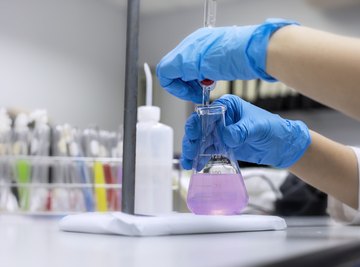

Titration can be a long and arduous task especially if you need to do it repeatedly. The automated titrator has solved many of the problems that make this task so tedious.
Definition of Titration
According to "General Chemistry: Atoms First," a "titration is a procedure for determining the concentration of a solution by allowing a carefully measured volume to react with a solution of another substance (the standard solution) whose concentration is known."
Chemical Reactions
Chemical reactions when balanced correctly provide a convenient relationship between the things reacting together (called the reactants) and their products. This relationship is a necessary factor in a titration.
Manual Titration
Performing a titration manually can require skill and time. The standard solution (that is, the one you know everything about) can be reacted with the other reactant (the one you wish to know the concentration of) to produce a particular amount of product. This method depends heavily on your eyes (watching for color change) and on the accuracy of your measurements.
Automated Titration
The whole process of titration is made much easier by making it automated. You simply add a predetermined amount of reactant and the machine will add the other reactant and measure the products to find the end point.
Benefits of Automated Titration
Many samples can be done in no time at all. The accuracy is increased due to the finely calibrated computer instead of your eyes. The amount of hands-on interaction is drastically reduced.
References
- "General Chemistry: Atoms First;" McMurry, John E.; Fay, Robert C.; 2010
About the Author
Philip J. Carlson is currently a Ph.D. candidate in the department of chemistry at Iowa State University. He earned a B.S. degree (cum laude) with majors in chemistry and mathematics. Carlson also has a B.A. in evangelism and missions, and an A.S. degree in chemistry. He has published in a number of peer-reviewed journals and even has a pending patent.