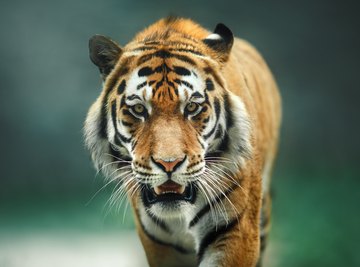

The tiger is a majestic creature, a huge apex predator with distinctive stripes and a solitary nature. Tigers today face incredible challenges as their numbers shrink in the wild due to poaching, encroaching human population, and loss of habitat and therefore traditional prey. Where tigers succeed, food webs remain intact and ecosystems remain stable. Tigers represent a keystone species necessary for their ecosystem to survive.
TL;DR (Too Long; Didn't Read)
Tigers serve as apex predators in their ecosystem. This keystone species requires large, interconnected territories for prey abundance. Tigers face incredible threats as they number in only the thousands today. Without tigers, entire ecosystems would collapse.
Tiger Facts
Tigers represent the world’s largest cat species. Nine subspecies of tiger are known, six of which remain today. The largest tigers can reach over 600 pounds, and up to 10 feet in length. The tiger’s iconic black-striped pattern on fiery-hued fur is unique to each individual. Tigers can swim well over long distances if needed; they eat only meat. They vocalize in grunts and roars and mark their territories with their urine, feces and scraping. Tigers can live up to 20 years in the wild, and cubs remain with mothers until they reach almost two years old. Nearly mature cubs require considerable meat for food.
Habitats of Tigers
The modern range of tigers extends through Asia, bounded from Russia to Sumatra and Southeast Asia. Tigers live in varied habitats such as grasslands, evergreen forests, tropical rainforests and mangrove swamps. Tiger territories must be large to allow for plentiful prey populations and to avoid inbreeding. Nearly 93 percent of tiger range no longer exists.
Hunting habits
Tigers hunt alone weekly, usually at night. Opportunistic hunters, tigers wait for potential prey under cover of darkness, camouflaged by their stripes. They hunt by sight and sound. Tigers prefer large mammals such as elephants, deer, banteng (a type of wild cattle), sambar (a type of deer) and gaur (another type of cattle) but will also eat monkeys, water buffalo, crocodiles and even leopards. They choose kill sites with low shrub cover but adequate crown cover for prey visibility. Because of human incursion into tiger habitats, the tigers' natural prey supply has dwindled. This results in tigers sometimes taking domestic livestock for prey.
Food Web Importance
Because tigers serve as apex predators, and the largest carnivore in their ecosystem, they control natural prey populations. This in turn controls primary producers (vegetation) eaten by tiger prey. This connection to the food web is essential, underscoring the importance of tiger conservation. Where tigers thrive, the watersheds millions of people rely on can remain intact.
Challenges for Tigers
Tigers suffer constant threat of poaching due to their being a status symbol in certain cultures. Their habitats have been destroyed or disconnected, and their natural prey has dwindled. As natural prey dwindled and tigers consumed more domestic animals, retaliation by farmers has increased. Removal of habitat due to human civilization also increases the likelihood of tiger and human conflict.
Less than 4,000 tigers remain in the wild, down from 100,000 a hundred years ago. Education, advocacy, patrolling to prevent poaching and even tourism for tigers remain crucial to prevent extinction. Between Nepal and India in the Terai Arc region, tiger populations are recovering thanks to linking protected areas and ecological corridors. These transboundary corridors allow for greater wildlife movement. If connected tiger habitat is conserved and protected elsewhere as well, hope remains that tiger populations can grow again and remain sustainable in their role as apex predator.
References
- World Wildlife Fund: Tiger
- Yale Environment 360: With Tigers Near Extinction, a Last-Ditch Strategy Emerges
- Smithsonian’s National Zoo & Conservation Biology Institute: Tiger
- Tropical Conservation Science: Ecological Covariates at Kill Sites Influence Tiger (Panthera Tigris) Hunting Success in Huai Kha Khaeng Wildlife Sanctuary, Thailand
- PLOS One: Tigers in the Terai: Strong Evidence for Meta-population Dynamics Contributing to Tiger Recovery and Conservation in the Terai Arc Landscape
- World Wildlife Fund China: Amur Tiger
About the Author
J. Dianne Dotson is a science writer with a degree in zoology/ecology and evolutionary biology. She spent nine years working in laboratory and clinical research. A lifelong writer, Dianne is also a content manager and science fiction and fantasy novelist. Dianne features science as well as writing topics on her website, jdiannedotson.com.