
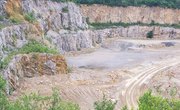
Sandstone and limestone are common rocks found throughout the world. They create some of the dramatic landscapes you can find across the U.S. As sedimentary rocks, they share certain similarities. However, their different origins and compositions make them unique.
Composition
Limestone is defined as being primarily composed of calcium carbonate, which often comes from plant and animal material such as the shells of mollusks.
Sandstone is not defined by any one substance. It consists of sand sized particles, which range from 0.0063 to 2mm in size. It often contains quartz,, though it does not have to. Other common components of sandstone include feldspar, mica, lithic fragments and biogenic particles.
Formation
Sandstone is formed from the breakdown of larger rocks due to weathering and erosion as well as from processes that occur within the rock, usually biologic but sometimes chemical in nature.
Limestone often forms from whole or pieces of a variety of organisms that contain calcium carbonate, such as mollusks, echinoids and corals. Most limestone beds form in marine environments where large deposits of organisms and carbonate precipitation build up over time.
Classification
Sandstone is often classified based on the type of grain it contains in large quantity. For example, ferriginous sandstone denotes a high iron content. More advanced classifications used by geologists combine descriptions of texture and composition.
Limestone may be informally described by the type of carbonate it contains, such as calcite, aragonite and dolomite. Again, geologists use more complicated classifications to describe limestone based on texture, formation and composition.
Appearance
Many sedimentary rocks, such as sandstone, display a visible stratification into layers. This distinct pattern can help determine how a rock was formed based on the angle and depth of each layer.
Limestone does not have the stratification pattern that sandstone does. Some limestone is composed entirely of organic material that may be clear to the naked eye. Other limestone is more compacted and therefore less differentiated.
Fun Facts
Weathering of limestone has created some dramatic landscapes. The Kwangsi region in Southern China has vast areas formations formed by the solution of limestone in water. Carlsbad Caverns in New Mexico is an elaborate series of limestone caves. The spectacular stalactites and stalagmites found in such caves are caused by the dripping of water containing dissolved calcium carbonate.
References
- "Sedimentology and Stratigraphy"; Gary Nichols; 2009
- "Geology and the Environment"; Bernard Pipkin; 2008
About the Author
Sancho Panza is a freelance health and outdoors writer. She has written for various online publications and is an avid hiker and rock climber.