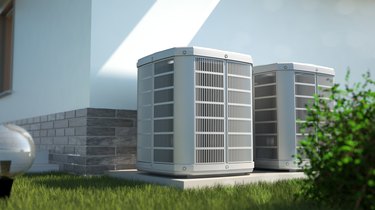
An HVAC system may provide heating or cooling, but one thing it always does is move air, which is why the acronym includes "V" for ventilation. HVAC technicians measure airflow in cubic feet per minute (CFM), and they use this measurement to match the size of an HVAC system to the size of the building it services. A system that's too small won't provide adequate heating or cooling, while one that's too big will cycle on and off too frequently, and the end result in both cases is wasted energy.
You can calculate CFM two different ways. One way is to calculate the ventilation requirements of the space based on its size and the frequency with which the air needs to be exchanged. The other is to calculate the capacity of the system based on its power, which is measured in tons, and the volume of the entire space it is ventilating.
Video of the Day
Video of the Day
Calculating Airflow Requirements for a Room
The number of air changes per hour is different for different rooms. For example, the air in a kitchen should change about every three minutes, a room with potentially dangerous fumes, such as a generator room, should have the air exchanged more frequently — about every two minutes — and a living room needs air exchanged about every 10 minutes. The calculation for CFM involves dividing the total volume of the space by the air exchange interval.
To calculate room volume, you measure its length, width and height in feet and multiply these. Dividing this number by the change rate gives the required airflow in CFM. For example, if a kitchen is rectangular with a width of 10 feet and a length of 20 feet and it has a standard 8-foot ceiling, its volume is 1,600 cubic feet. The air needs to be exchanged every three minutes, so the flow rate should be 1,600/3 = 533 CFM. A generator room of the same size would need a flow rate of 1,600/2 = 800 CFM, while a living room would need only 1,600/10 = 160 CFM.
Calculation Based on System Output
The airflow capacity of an HVAC unit is measured in CFM per square foot, and this number is important when it comes to determining if a unit is big enough for a building as well as sizing ducts. To calculate it, you need to know the output of the unit in tons, where 1 ton = 12,000 British thermal units (BTUs) of heating or cooling capacity. You multiply this by 400, which is the average output of an HVAC unit, and divide by the square footage of the building.
For example, a 10-ton HVAC unit servicing a 2,000 square foot building would deliver airflow at a rate of: 10 tons x 400/2,000 = 2 CFM per square foot. A 200-square-foot kitchen would get air at a rate of 400 CFM, which wouldn't be enough to exchange the air every three minutes, but if the kitchen were smaller — say 100 square feet — it would be plenty.
CFM Charts and Automatic Calculators
When sizing HVAC systems, technicians regularly use charts and automatic calculation programs to calculate airflow. These are usually based on a standard ceiling height of 8 feet and depend on converting the air exchange rate to air changes per hour (ACH). In the kitchen example, the air needs to be exchanged every three minutes, so the ACH is 15. Most rooms have much lower air exchange requirements, with ACH in a range from 2 to 5, which is why kitchens usually have auxiliary exhaust fans.