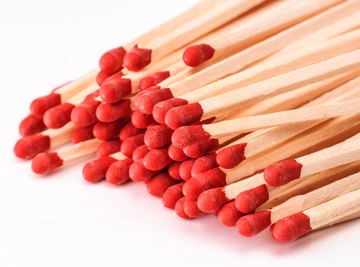

Why would anyone need red phosphorus? Well, it turns out this combustible material has many uses. It's a primary ingredient in fireworks and flares, and it's the main ingredient in strike-anywhere matches and in striking plates for safety matches. It also has uses that aren't related to its combustibility. It's an important component of plant fertilizers, and it's one of the elements chip manufacturers use to dope silicon to make more efficient semi-conductors. Counterintuitively, when mixed with plastics and resins, red phosphorus can also be used as a flame retardant. It's also one of the ingredients the fictional teacher-turned-drug dealer Walter White used to manufacture methamphetamine.
You can actually purchase red phosphorus online, although your source is likely to be located in China or some other part of Asia. Because of its connection to meth production, the U.S. Drug Enforcement Administration regulates the sale of red phosphorus in the United States, along with white phosphorus and hypophosphorous acid (H3PO2). These regulations also affect importation, so if you're living in the United States, importation may be illegal, depending on your purpose. However, the European Chemical Agency estimates that 1,000 to 10,000 tons of phosphorus are manufactured each year for use in industry, so there is plenty out there to be had.
Technically, you could make your own red phosphorus. The process isn't that difficult, although it involves letting a container of urine stand for a week or more, so it's distasteful. If you prefer not to work with urine, you can also refine phosphorus from bone ash or phosphorus-rich minerals. Both processes yield white phosphorus, which can be converted to red phosphorus.
The Discovery of Phosphorus and Its Allotropes
The 15th element in the periodic table, phosphorous (P) was discovered accidentally by alchemist Hennig Brand in 1669. Brand was searching for the philosopher's stone, which was a way to refine gold from base metals. He was the first to refine phosphorus from urine, and he gave it the name phosphorus (light bearer) because it glowed in the dark.
What Brand produced was actually white phosphorus, which is one of the three main allotropes. In this form, phosphorus is so unstable that it has to be kept underwater to prevent it from bursting into flames. It wasn't until 1845 that an Austrian chemist, Anton von Schrötter, discovered red phosphorus, a more stable allotrope. He obtained his first sample by heating white phosphorus to a temperature of 250 degrees Celsius (482 F). The third main allotrope is black phosphorus, which is even more stable than red phosphorus but not as useful.
All three allotropes of phosphorus have the same chemical composition: P4. The four phosphorus atoms are arranged in a tetrahedral structure, but subtle variations exist in the bonds holding them together. These differences account for the higher boiling and melting point of red P, compared to white P, and its lower reactivity.
Refining Red Phosphorus From Urine
Brand's process for making white phosphorus was time-consuming. He filled a container with urine and let it stand until it putrified; he then boiled it down into a paste, which he heated to a high temperature. He collected the vapors in water where they condensed into white phosphorus.
Warnings
White phosphorous is toxic and must be kept underwater. If you allow it to be exposed to the air, it will spontaneously ignite. Do not attempt to make white phosphorus.
The refining procedure involves two reactions. In the first, ammonium sodium hydrogenphosphate is heated to produce sodium phosphite, ammonia and water. When you heat sodium phosphite with charcoal, which is essentially carbon, the products are sodium pyrophosphate, carbon monoxide and white phosphorus.
In 1680, chemist Robert Boyle improved on Brand's process by adding sand (silicon dioxide) to the second reaction to liberate all the phosphorus from the sodium pyrophosphate.
To obtain red P, you must heat the white P obtained in this process and hold the temperature constant for an extended period. The degradation from white to red phosphorus can happen spontaneously at room temperature, but it takes much longer.
Obtaining Red Phosphorus From Bone Ash or Rocks
Another method used since the late 1700s produces phosphorus from bone ash or rocks. In this method, you reduce animal or fish bones to ash, or you grind up phosphorus-rich rocks, such as pyromorphite, and treat the ash or powder with sulfuric acid. The reaction produces phosphoric acid and calcium sulfate. A concentrated form of the acid is combined with a certain type of charcoal over flame to distill white phosphorus. The white phosphorus has to be heated to produce red phosphorus.
Which Foods Are High in Phosphorus?
The fact that you can obtain phosphorus from urine suggests that the human body needs a certain amount of phosphorus. This is true, and it's also true for animals and plants. As far as human beings are concerned, phosphorus is important in the formation of bones and teeth, it's needed for the body to manufacture proteins and it's a key component in the formation of adenosine triphosphate (ATP), which the body uses for energy. The kidneys release excess phosphorus into the urine, which is why urine is such a good source of it.
The main food sources of phosphorus are milk and meat – specifically chicken, pork and organ meats. Seafood is also rich in phosphorus. Other high-protein foods, such as beans, lentils and peas, are also good sources. You can get small amounts of phosphorus from whole-grain bread and cereal, nuts, seeds and chocolate. Sprouting seeds and nuts increases the bioavailability of the phosphorus they contain. You can also get phosphorus by eating quinoa and amaranth.
Plants also need phosphorus to make them strong and resistant to disease. Phosphorus-rich fertilizers are often made using bone ash as a primary ingredient. Bat guano is also rich in phosphorus and makes a good fertilizer.
References
Tips
- Red phosphorus is stable in air, and can be transported safely without immersion in water. The California Environmental Protection Agency indicates, however, that the substance is still toxic and should be handled carefully.
- Either a heating element or focused sunlight can be used to heat the airtight container to the necessary temperature.
Warnings
- White phosphorus is extremely reactive and spontaneously combustive in air. It must be continuously immersed in water. Take extreme care to ensure white phosphorus never comes into contact with air.
- White phosphorus is extremely toxic. If exposed, seek medical attention immediately.
- Due to the danger of using white phosphorus, the production of red phosphorus should occur only under controlled circumstances by experts in handling phosphorus.
- Law enforcement agencies in many regions keep a close watch on red phosphorus because of its use in making methamphetamine. Contact law enforcement for information on laws and ordinances regarding the transport or use of phosphorus compounds.
About the Author
Chris Deziel holds a Bachelor's degree in physics and a Master's degree in Humanities, He has taught science, math and English at the university level, both in his native Canada and in Japan. He began writing online in 2010, offering information in scientific, cultural and practical topics. His writing covers science, math and home improvement and design, as well as religion and the oriental healing arts.