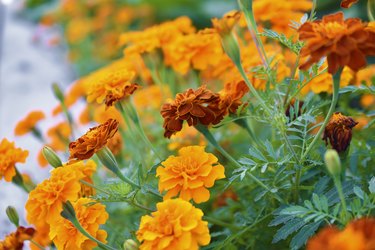
Marigolds have many of the qualities you might seek in a spouse: They are cheerful, undemanding, attractive, and long lasting. These gardener-favorites light up your annual beds in happy colors like yellow, orange, and red, and keep right on blooming all summer long.
Wilting marigolds are a sad sight indeed, and the likely culprit can be anything from too little or too much water to fatal fungal or bacterial diseases.
Video of the Day
Video of the Day
Meet the Marigold
It's not difficult to find a marigold (Tagetes spp.). Just look in the annual gardens up and down the block. It is one of the most common bedding flowers as well as one of the easiest to grow and most reliable.
Marigolds are often called the most cheerful of flowers. Can a flower be cheerful? It's open to debate, but the warm colors and fern-like foliage of these annuals are enough to improve the mood of any gardener.
This may be the only common denominator between different types of marigolds, however, since the size and form of the flowers range considerably from tiny signet marigolds (Tagetes tenuifolia) to huge African marigolds (Tagetes erecta) to elegant, French marigolds (Tagetes patula). However, as members of the aster family, every type of marigold looks a bit like a daisy.
Care for Marigolds
You can grow marigolds by seeding in spring time, with flowers to show for your efforts a few months after the seeds go in the ground. However, many gardeners buy trays of nursery starts and fill up the beds with them. Keeping marigolds healthy is a matter of planting them in spring in an appropriate growing location and providing adequate water.
Marigolds are the color of sunshine, so when you admire them in the garden store, keep sunshine in mind. Marigolds absolutely require a sunny location. They may limp along in partial shade, but the more shade the plants must deal with, the fewer blooms they will offer and the greater chance that they will have fungus issues. This could be anything from powdery mildew to the dreaded Verticillium wilt.
Excellent drainage is also part of the program. Marigolds are extremely easy-care, but they love water and prefer regularly moist soil. This only works if that soil permits easy, efficient drainage, however. When the plants have their roots in wet soil, root rot and fungal diseases can result. Favor soaker hoses and avoid overhead irrigation to give your plants their best chance. Blending in organic compost will enrich the soil to help them along.
Diagnose Wilting Issues
A wilting marigold might just be thirsty, but it might be attacked by a lethal disease. Assess the cultural care. Marigolds need water, especially just after transplanting. If they don't get enough water, they will wilt; then, if water still is not forthcoming, die.
Too much water is another potential cause of wilting. That is, if you give the plants lots of water but the soil doesn't drain well, the plants might get root rot, stem rot, or crown rot.
Too much moisture can also allow various severe fungal/bacterial wilt diseases to infect marigolds. These include Verticillium wilt and Southern bacterial wilt. Both can dwell in the soil and in infected plant parts. For both, the foliage yellows before the plant wilts. Neither of these is curable, and the plants and surrounding soil should be removed and disposed of.