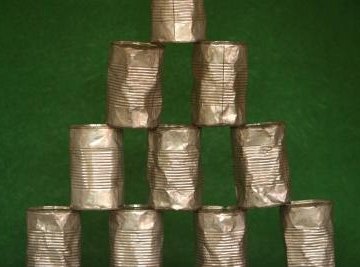

Are Tin Cans Attracted to a Magnet?

Tin, abbreviated Sn on the periodic table, has multiple forms or allotropes. The one used commercially, white tin, is paramagnetic, meaning that it does not create a magnetic field of its own but is magnetized in the presence of external magnetic fields. Most "tin cans," though, are not made entirely of tin.

  1. Invention

    • The tin can was patented by British inventor Peter Durand in 1810 as a novel method of food preservation. The earliest tin cans were made of iron coated with a thin layer of tin for corrosion resistance.

    Evolution

    • Tinplate steel, or steel with a very thin coating of tin, eventually replaced iron. In 1957, manufacturers began using aluminum instead. Aluminum simplified production by making cans from two pieces of metal rather than three. The bottom of the can is aluminum, while the cap is tinplate steel. In 1965, some manufacturers began coating steel cans with chromium instead of tin. Nearly all of these products are still colloquially referred to as "tin cans."

    Magnetism

    • Iron, steel, tin and aluminum are paramagnetic materials -- so regardless of the composition of your "tin" can, it will be attracted to a magnet.

Related Searches:

References

Comments

You May Also Like

  • How to Tin Magnet Wire

    Tinning wire usually means first removing the insulation with a wire stripper, then applying heat and solder to the exposed copper. Magnet...

  • How to Tell Which Cans Are Aluminum

    Metal cans have a long history. The first beverage cans were made out of steel, according to Absolute Astronomy. The Coors Brewing...

  • How to Identify Tin Plating

    Tin plating has been a common practice in the past for electronic components, including pieces used in satellites, according to ieeexplore.ieee.org. However,...

  • How to Identify Tin Cans

    "Tin can" is the informal name for the thin metal cans used to store goods, most often preserved foods. Tin cans are...

  • Are Magnets Attracted to Cotton?

    A magnet can react to a substance in one of three ways: it can be strongly attracted, weakly attracted or weakly repelled....

  • Types of Metals That Attract Magnets

    Different materials react very differently in the presence of a magnet. Metals such as iron, nickel and cobalt are strongly attracted to...

  • Why Does a Magnet Attract Iron?

    A magnet attracts iron because the iron particles in a steel magnet align in north/south directions and are then able to react...

  • How to Recycle Tin Cans in a Kiln for Crafting

    Metal-casting is a craft activity that appeared to evolve around 3,000 BCE. The process of metal-casting involves many of the same steps...

  • The Composition of Tin Cans

    Tin cans have been used for food storage since the beginning of the 19th century. The cans provide an airtight container which...

  • What Materials Are Attracted to Magnets?

    Magnetism comes in a variety of forms. Ferromagnetic materials have strong magnetic attraction. Iron and similar metals have this property. Most other...

  • How to Make Magnetic Spice Tins

    A magnetic spice rack is a chic and space-efficient alternative to the clunky counter-top version. It hangs the tins on a wall...

  • How to Test for Bronze With a Magnet

    Bronze is a non-magnetic metal alloy made up of tin and copper. Due to its non-magnetic properties the presence of bronze can...

  • List of Recyclable Aluminum Cans

    Recycling aluminum cans benefits society for a number of reasons. First, the cans are kept out of a landfill, saving valuable space...

  • Tin Can Projects for School

    Use recycled tin cans to create fun classroom activities and projects along with discussing the concept of recycling. Have students bring in...

  • Why Are Magnets Used in Recycling?

    Magnets are a vital tool used in recycling. Recycling consists of separating different types of metals and alloys, based on the elements...

  • What Kind of Objects Are Attracted to Magnets?

    Electric motors, computers, even super-speed trains all use magnets. Fun to play with as a kid or even an adult, the mystery...

  • Why Are Metal Pop Cans Lined With a Plastic Coating?

    Pop cans, or soda cans, are typically treated with a plastic coating that protects the aluminum material of the metal container from...

  • What Types of Metal are Attracted to Magnets?

    Something is considered magnetic when it can either attract or repel other magnetic objects. Magnets are characterized by their atomic composition, with...

Related Ads

Featured