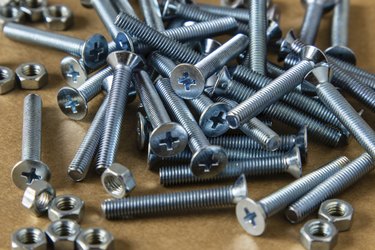
When people speak of the "nuts and bolts," they're generally talking about the basics or the practical essentials of something. Indeed, physical nuts and bolts serve as fundamental components in many construction projects. While they're a ubiquitous sight among any builder's materials, both nuts and bolts come in a wide array of styles, each dedicated to a particular function.
Hex Bolts
Video of the Day
You can identify hex bolts by their hexagonal or "hex"-shaped heads. A hex bolt's shaft may have threading all the way up to the head, or it may be only partially threaded. You can use a hex bolt with a nut or with a tapped hole. Hex bolts are sometimes referred to by the abbreviations HHMB or HXBT.
Video of the Day
Hanger Bolts
It's easy to identify a hanger bolt from any other bolt type, as they do not have the basic structure of a head and a shaft. Rather, the hanger consists of a single shaft with different threadings on either end. It works to connect a wood element, for which one end has wood threading, with another element, which takes a machine thread.
Carriage Bolts
You can identify the carriage bolt by head, which is rounded and lacks any indentation for a screwdriver. Directly beneath the smooth head, a carriage bolt has a square element before tapering into its partially-threaded shaft. The end of a carriage bolt is flat, like most bolts, with the exception of the lag bolt.
Chicago Bolts
Chicago bolts, barrel nuts or sex bolts are all names for the same uniquely-shaped type of bolt. Unlike other bolts, which have threading along the outside of a cylindrical shaft, the Chicago bolt has a hollow shaft that is smooth on the outside and threaded along its interior. This form is also known as a "female" thread. Chicago bolts fit together with regular ("male") bolts in the same way that normal nuts do. However, as they have a head and a shaft component, many still classify them as bolts.
Hex Nut Types
A basic hex nut has six sides and is also called a "finished hex nut." As it serves as the most common type of nut, several variations exist. A nylon insert lock, or nylock, is a hex nut with a nylon insert that helps to hold it securely in place. A jam nut is a shorter hex nut. A nylon insert jam lock is, accordingly, a shorter nylock.
Wing Nuts
Popularly used for craft projects and other temporary fastening, wing nuts have heads sculpted into two "wings." The wings are easy to grip between the thumb and forefinger, making it possible to tighten the wing nut by hand.
Cap and Acorn Nuts
A cap nut is closed on one end, with a smoothly-domed top. It works best for applications where very little of the bolt is exposed, or where the cap nut doesn't need to screw down fully along the length of the bolt's shaft. An acorn nuts has roughly the same design as a cap nut, except that its rounded end has a higher crown.