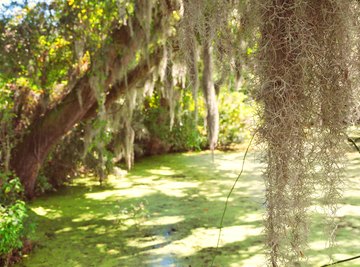

Symbiotic relationships involve an organism that lives on another and thereby derives some advantage, which may or may not be mutual. The relationship between Spanish moss and the trees it colonizes is an example of symbiosis.
Types
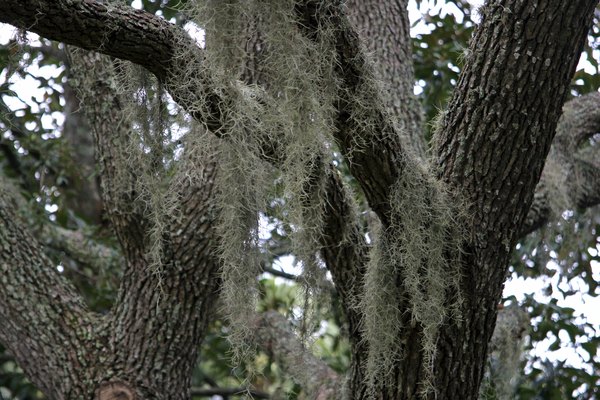
Spanish moss is a type of epiphyte, a plant that lives on another. Epiphytes are distinct from parasitic plants in that they make their own food, so they do not harm the host tree; the host tree neither gains nor loses by their presence. Ecologists call this kind of relationship commensalism.
Features
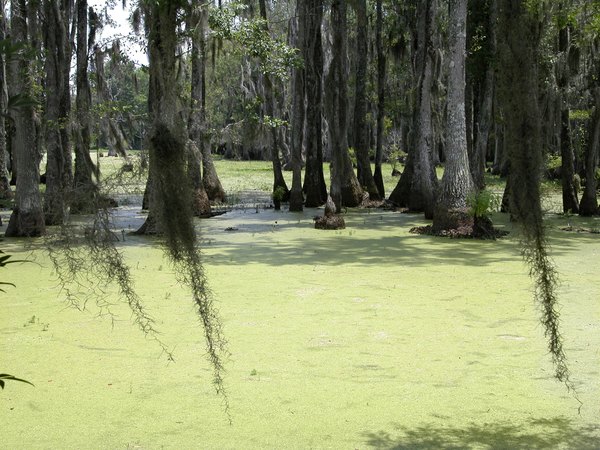
The Spanish moss plant does not have any roots; it wraps itself around the branches of the tree and collects water through special scale-like structures on its leaves. Its favorite hosts are oak and cypress, although it sometimes grows on other trees as well.
Considerations
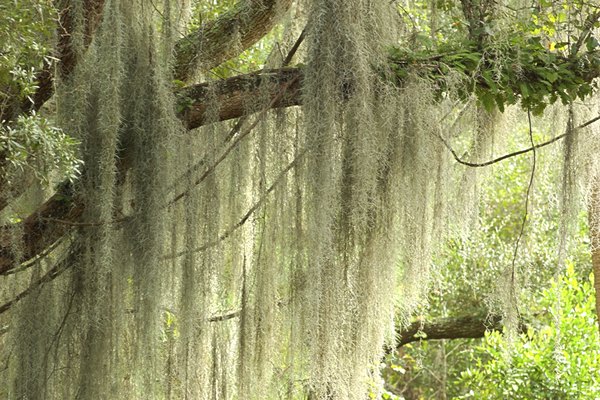
Like other green plants, Spanish moss is a photosynthesizer. Although it is not a parasite, it can upon occasion harm the host tree, especially if the plant grows to the point where it blocks light from reaching some of the tree's leaves or becomes so heavy the branch breaks beneath its weight. Occasional trimming should be sufficient to avert both of these problems.
References
- "Biology, 8th Edition"; Neil Campbell, Jane Reece, Lisa Urry, Michael Cain, Steven Wasserman, Peter Minorsky, Robert Jackson
About the Author
Based in San Diego, John Brennan has been writing about science and the environment since 2006. His articles have appeared in "Plenty," "San Diego Reader," "Santa Barbara Independent" and "East Bay Monthly." Brennan holds a Bachelor of Science in biology from the University of California, San Diego.
Photo Credits
Caleb Harper/iStock/Getty Images