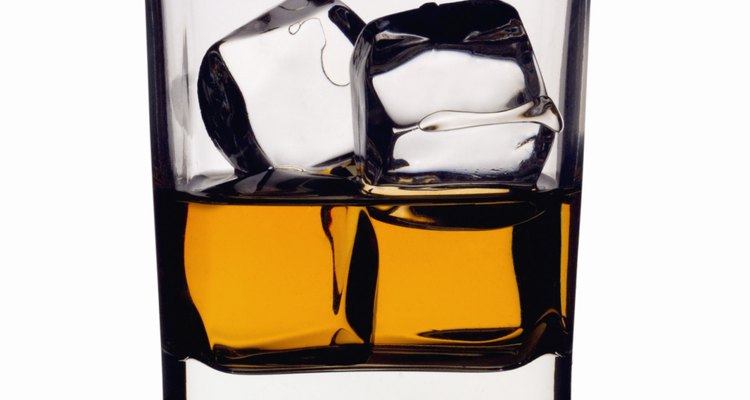
The proof may vary in the pudding, but proof in alcoholic beverages is scientifically defined and legally regulated. United States regulations, implemented by the U.S. Department of the Treasury require clear labeling of the alcoholic content of beverages, but information can be difficult to understand. British and European regulatory agencies calculate proof with different methodologies. The relationship between alcoholic content and proof needs clarification for many consumers.
Definition of Proof
Proof is the measure of the amount of alcohol in a standard drinking or medicinal liquid, an expression of the strength of the liquid. According to tradition, the modern concept of proof dates from the early 18th century, when British seamen were issued a daily ration of rum. To assure an honest and consistent supply, rum was tested, or proved, by being mixed with gunpowder. Rum containing 57.15 percent ethyl alcohol, or ethanol, by volume was graded as 100 proof because, at that alcoholic concentration, the rum mixture could be ignited and burned with a steady flame. Although the exact relationships between proof and alcohol content have changed over time, proof still serves as a quick way for consumers to rate the strength of their purchases.
Alcohol Content by Volume
In the U.S., proof measures the percentage of alcohol by volume in a liquid. A mixture composed of 1 cup of alcohol and 1 cup water contains 50 percent alcohol by volume. The proof rating is twice the percentage, making the mixture 100 proof. Since alcohol is volatile and partially or fully evaporates when heated, alcoholic volume and proof are determined at a temperature of 60 degrees Fahrenheit.
Alcohol Content by Weight
British proofing combines comparisons of volume and weight to establish beverage strength. Equal volumes of water and the beverage are compared by weight. Since a volume of alcohol weighs less than the same volume of water, proof is calibrated based on the weight difference. A cup of water weighs approximately 16 ounces; a cup of alcohol weighs 12.8 ounces, or a conversion factor of 0.79. A 100-proof alcoholic beverage weighs 12/13 of a similar volume of water, which adheres to the traditional British rating of 57.15 percent alcohol by volume. According to this formula, a beverage rated as 100 proof in the U.S. rates as 87.6 proof in Britain.
Degrees Gay-Lussac
A bottle of French wine may contain alcohol-content information expressed in GL, or degrees Gay-Lussac. Measured by a hydrometer and based on volume, each degree Gay-Lussac corresponds to one percentage point. A beverage with an alcohol percentage of 40 by volume would rate 40 degrees Gay-Lussac. Calculated by the U.S. formula, 40 degrees Gay-Lussac would be 80 proof. Degrees Gay-Lussac can be particularly useful when choosing among varieties and vintages of wine.
European Union Proof Ratings
The International Organization of Legal Metrology allows standards for European Union members to be based on alcohol by weight (ABW) or alcohol by volume (ABV), measured at a temperature of 20 degrees Celsius, or 68 degrees Fahrenheit. Imported wines and liquors may therefore display ABW, ABV and degrees Gay-Lussac information. The IOLM also sets alcohol-content ranges for lager beers, wines, liqueurs and distilled spirits.
Related Articles
What Is the Difference Between 80 & 100 ...

Alcohol Content: Proof vs. Percentage ...
Chocolate Martini: How Many Calories?
How Strong Is 120 Proof Vodka?
How Much Is a Single Serving Size of a ...
The Difference Between Fruit Juice & ...
Calories in Charles Shaw Wine
Properties of Propylene Glycol
MSG and Parmesan Cheese

What Is the Highest Proof Tequila?
German Beer Vs. American Beer

Does Brandy Freeze?

Shoe Sizes Explained
What Happens to the Alcohol ...
Calories in Peppermint Extract
How to Measure Water Temperature With ...
Types of Bacteria in Wine
What Is the Highest Proof Vodka?
Proper Ratios on Mixed Drinks
How to Calculate Degrees of Brix
References
Resources
Writer Bio
Janet Beal has written for various websites, covering a variety of topics, including gardening, home, child development and cultural issues. Her work has appeared on early childhood education and consumer education websites. She has a Bachelor of Arts in English from Harvard University and a Master of Science in early childhood education from the College of New Rochelle.
Photo Credits
George Doyle/Valueline/Getty Images