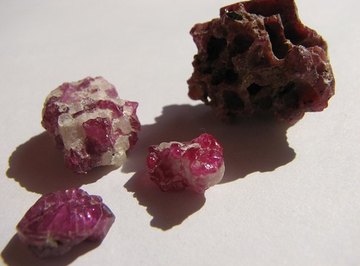

There are three forms of weathering, constituting physical, chemical and biological processes. Though weathering can be confused with erosion, there are subtle differences. Erosion occurs with the breakdown, transportation and deposition of material, while weathering alters or disintegrates material at its original position. Silicate weathering can help shape the Earth's surface, regulate global and chemical cycles and even determine nutrient supply to ecosystems.
Identification
If you go outside and pick up a rock in your backyard, chances are you are holding a rock that contains silicate minerals. Silicates make up approximately 95 percent of the Earth's crust and mantle and are a major component of igneous rocks--crystalline or glassy rocks formed by the cooling and solidification of magma. Minerals with this combination of silicon and oxygen are also found, though less abundant, in sedimentary rocks (formed by other rock fragments and cemented together) and metamorphic rocks (formed by the heating and pressurization of existing rock).
Makeup
The prime makeup for all silicate minerals is the silicon-oxygen tetrahedron--a solid bounded by polygons with four faces. The composition includes a central silicon cation bonded to four oxygen atoms that are located at the corners of a regular tetrahedron. Approximately 25 percent of all known minerals and 40 percent of the most common ones are silicates. The bonds that tie silicon and oxygen are developed by oppositely charged ions and shared electrons.
Weathering
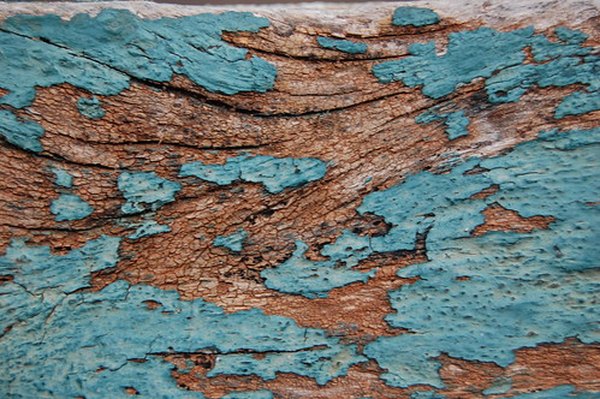
The Earth's surface is shaped via weathering, from either physical, chemical or biological factors. These factors can act separately or as a combined force. Physical weathering causes the disintegration of rock material without the presence of decay. Thermal expansion--the alternating process of freezing and thawing as evident in the northern part of the United States and most of Canada--is the primary source for physical weathering. Chemical weathering occurs when the mineral composition of a rock is altered.
The Big Picture
According to Sigurdur R. Gislason, Institute of Earth Sciences (Iceland) and Eric H. Oelkers, Géochimie et Biogéochimie Experimentale (France), "silicate weathering (chemical weathering) is thought to control climate by consuming atmospheric carbon dioxide (CO2)" over a geological time scale. The CO2 is eventually stored as carbonates in the ocean. One third of silicate weathering is the result of weathering on volcanic islands and continents. The atmospheric CO2 consumption flux is due largely in part of the high weathering rate of basalt. For each increase of one degree in temperature, chemical weathering rates increase by approximately 10 percent. But most silicates dissolve inconsistently with weathering as they are attached with other minerals such as clays. These suspended silicates carried to the oceans are highly reactive in ocean waters and thereby dependent on climate.
Impact

Of the rocks exposed at the Earth's surface, approximately 90 percent constitute silicates. Approximately a quarter of that rock is intrusive--for example, granite--a quarter is extrusive--volcanic--and the other half is metamorphic and "Precambrian"--a period of time that extends from about 4 billion years ago (the approximate age of the oldest known rocks) to 542 millions years ago. Being of silicate makeup, volcanic rock weathers the quickest. But it will take over 1 million years for silicate weathering to stabilize atmospheric CO2, even though silicate weathering accelerates CO2 removal. Given this timescale--vegetation suppression and rates of weathering--the CO2 levels will return to above those of pre-industrial times.
References
- "The American Heritage Dictionary of the English Language;" William Morris, Editor; 1981
- Silicates
- The Geochemistry of Silicate Rock Weathering
About the Author
Julia Ferrini was an editorial assistant, copy editor, journalist and photojournalist for the "Newark Post" in Newark, Delaware. She holds an associate degree in humanities from Erie Community College with a concentration in English. She also has more than 10 years professional and practical experience in the writing field.
Photo Credits
Image by Flickr.com, courtesy of Jarno