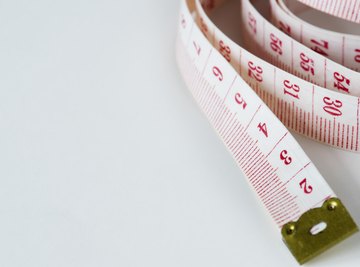
The metric system of measurement is so much easier to use than the British Imperial system -- which is somehow still in use in the United States in 2018 -- that every country in the world except three has adopted it. Even the United Kingdom has made the change. Instead of the 12 gradation units of the imperial system, the metric system is based on gradations of 10 and powers of 10. This makes it simple to express fractions of a unit in decimal form. To make expressing measurements even easier, metric units contain prefixes to denote the power.
TL;DR (Too Long; Didn't Read)
The metric system measures mass in grams or kilograms, distance in meters or kilometers, and volume in liters. It measures temperature in Kelvin or Celsius degrees instead of the Fahrenheit degrees used in the imperial system.
The Basic Unit for Mass
The metric system measures mass in grams. When the term was first introduced, it was intended to refer to the mass of 1 cubic centimeter of water at 4 degrees Celsius, but today it is based on a reference weight kept at the International Bureau of Weights and Measures near Paris, France. 1 gram is equivalent to 0.0022 pounds.
The Basic Unit for Length or Distance
The unit for distance, the meter, was originally intended to equal one ten-millionth of the distance from Earth's equator to its pole. Today, it refers to a distance between a pair of lines on a platinum-iridium bar kept at the International Bureau of Weights and Measures. 1 meter is a little longer than a yard -- 3.28 feet, to be exact.
The Basic Unit for Volume
The liter, which is the basic unit of volume, was originally defined as the volume occupied by 1 kilogram of water, but today it's simply one-thousandth of a cubic meter. As such, it's a derived unit. One liter is roughly equal to a quart; it's actually equal to 1.057 quarts.
Prefixes Denote Powers
The metric system uses prefixes to denote fractions or multiples of these basic units. Except for powers of 1, -1, 2 and -2, the prefixes are applied in increments of powers of 3, or one thousand. For example, one thousand meters is a kilometer, and one thousandth of a meter is a millimeter. While there are more prefixes, here is a list of from 10-15 to 1015:
- Femto- 10-15
- Pico- 10 -12
- Nano- 10-9
- Micro- 10-6
- Milli- 10-3
- Centi- 10-2
- Deci- 10-1
- Deka- 101
- Hecto- 102
- Kilo- 103
- Mega- 106
- Giga- 109
- Tera- 1012
- Peta - 1015
Tips
Two variations of the metric system exist. One is the MKS (Meter-Kilogram-Second) system and the other is the CGS (Centimeter-Gram-Second) system. Scientists prefer the CGS system, while the MKS system is more useful for everday use.
Measuring Temperature
The Fahrenheit scale is based on a zero-point created by mixing ice and salt in a precise concentration. By contrast, the zero-point of the Celsius scale is the freezing point of water at sea-level air pressure, and 100 degrees Celsius is the boiling point. The scale is subdivided equally between these points. Thus, 1 degree Celsius equals 1.8 degrees Fahrenheit. The Kelvin, or Absolute, scale is also used in the metric system. The degree increments are the same, but the 0 point on the Kelvin scale is absolute 0, which is -273.15 degrees Celsius.
References
About the Author
Chris Deziel holds a Bachelor's degree in physics and a Master's degree in Humanities, He has taught science, math and English at the university level, both in his native Canada and in Japan. He began writing online in 2010, offering information in scientific, cultural and practical topics. His writing covers science, math and home improvement and design, as well as religion and the oriental healing arts.