When a patient is unable to meet his nutritional needs by normal ingestion of food, a feeding tube can be placed, allowing nutrition to be delivered directly to the stomach or intestines. A feeding tube can be temporary or permanent, depending on the needs of the patient 1. The Dobhoff feeding tube (also referred to as an NG tube) and PEG (percutaneous endoscopic gastrostomy) tube are the most common feeding tubes used.
Dobhoff Feeding Tube
The Dobhoff feeding tube is inserted through the nose and passed through the esophagus to the stomach. Proper placement of the feeding tube must be confirmed in order to lessen the risk of complications. Nutrition formulas and certain liquid medications can then be passed though the tube in order to provide the patient with adequate nutrition.
Advantages of Dobhoff Feeding Tubes
What Can You Eat With a Feeding Tube?
Learn More
Advantages of the Dobhoff feeding tube include the ease of placement and removal as no surgery is required to place the tube, and the relative low cost.
Disadvantages of Dobhoff Feeding Tubes
Because the Dobhoff feeding tube is semi-rigid, it may become uncomfortable after an extended period of time. Therefore, a Dobhoff feeding tube is generally used only in patients who will need tube feedings for less than 2 to 3 weeks.
PEG Tube
What Are the Different Types of Feeding Tubes?
Learn More
The PEG tube is placed during a minor surgical procedure in which a tube with a camera is placed in the mouth and passed through the esophagus to the stomach. The camera allows the surgeon to see the inside of the stomach and ensure proper placement of the feeding tube. The feeding tube is inserted through an incision in the abdominal wall, and rests in the stomach and exits through the skin. As with the Dobhoff feeding tube, feeding formulas and certain medications can be passed through the tube to provide adequate nutrition.
- The PEG tube is placed during a minor surgical procedure in which a tube with a camera is placed in the mouth and passed through the esophagus to the stomach.
- The feeding tube is inserted through an incision in the abdominal wall, and rests in the stomach and exits through the skin.
Advantages of PEG tubes
Advantages to the PEG tube include patient comfort, ability for increased patient mobility, and the ability to use the PEG tube for feedings indefinitely.
Disadvantages of PEG tubes
The major drawback to PEG tube feedings is the increased risk of infection around the incision site. Proper wound care is important in patients who have a PEG tube 2. With a PEG tube, there is also a slightly higher risk of a patient aspirating (inhaling fluid into the lungs) if he has a decreased level of awareness, i.e. dementia.
Related Articles

What Can You Eat With a Feeding Tube?
Learn More

What Are the Different Types of Feeding Tubes?
Learn More
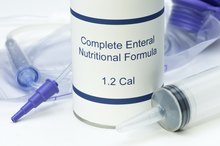
Isocal Nutrition Information
Learn More

What Are the Dangers of a Feeding Tube in the Elderly?
Learn More

Side Effects of Milk of Magnesia
Learn More

Nursing Care Plans and Nutrition
Learn More

Medications to Avoid After Gastric Bypass
Learn More
How Is a Feeding Tube Removed?
Learn More
Polycose Nutrition Information
Learn More

Diets to Treat Ileus
Learn More
References
- The American Society for Parenteral and Enteral Nutrition
- Provides information to support patients using nutrition support
- Sullivan SN. Functional abdominal bloating with distention. ISRN Gastroenterol. 2012;2012:721820. doi:10.5402/2012/721820
- The Oral Cancer Foundation. Nutrition/feeding systems.
- Philpott H, Garg M, Tomic D, Balasubramanian S, Sweis R. Dysphagia: Thinking outside the box. World J Gastroenterol. 2017;23(38):6942–6951. doi:10.3748/wjg.v23.i38.6942
- Blumenstein I, Shastri YM, Stein J. Gastroenteric tube feeding: techniques, problems and solutions. World J Gastroenterol. 2014;20(26):8505-24. doi:10.3748/wjg.v20.i26.8505
- U.S. National Library of Medicine. MedlinePlus. Jejunostomy feeding tube. Reviewed October 29, 2018.
- American Society for Gastrointestinal Endoscopy. Understanding percutaneous endoscopic gastrostomy (PEG).
- U.S. National Library of Medicine. MedlinePlus. Feeding tube insertion - gastrostomy. Reviewed May 20, 2018.