



The American flag is a symbol of patriotism that has changed many times since its first creation, but the meaning has remained the same; one nation indivisible. A nation's flag is usually the first thing another nation sees. The U.S. flag is a banner in war, a heraldry in times of peace and a symbol of every American's pride. There are some interesting facts about the American flag that often fascinate kids.
Stars and Stripes

The flag was originally designed with 13 stars and 13 stripes. According to the first Flag Act passed by Congress, the stars were to represent a new constellation. Over the years many people have attributed meanings to the colors on the flag, but none has ever officially been given. The 13 stripes represent the 13 original colonies and the stars in the corner represent the states, one star for each state in the union.
Colors

The colors of the flag have not been officially correlated with any meanings, but the official seal of the US contains the same colors and it was given meaning. According to USFlags.org, “White signifies purity and innocence, Red, hardiness & valour, and Blue, the color of the Chief (the broad band above the stripes), signifies vigilance, perseverance & justice.” It can be assumed that these meanings can also apply to the flag.
History
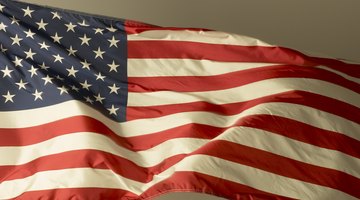
On January 1, 1776, General George Washington's forces were laying siege to Boston, which was under British control. He ordered the raising of the Grand Union flag, which had 13 alternating red and white stripes and the British Union Jack in the upper left-hand corner. In May of 1776 Betsy Ross claimed to have sewn the first American flag by hand, though this claim remains unproven. On June 14, 1777, the Continental Congress passed the first Flag Act, which officially created the flag, with 13 stripes and stars.
Old Glory
The term “Old Glory” has been used for centuries to describe the American flag. In 1831, Captain William Driver, a ship master of Salem, Massachusetts was leaving on a voyage aboard the Charles Doggett. He was presented with a flag containing 24 stars and hoisted it up on the pole. As the wind caught it on the open sea, he exclaimed, “Old Glory!” When he retired, he kept the flag with him and hid it, until during the civil war, when the Union had captured Nashville and were in need of a decent banner, Captain Driver uncovered his Old Glory and personally hung it on the flag pole in town.
The Pledge

In 1892 Francis Bellamy, a writer for Boston's “The Youth's Companion” magazine, wrote what would become the Pledge of Allegiance. It was originally printed as a few words for students to repeat on the quadricentennial of Columbus Day, that year. It then became a required school-day ritual to recite these words. In 1942, Congress officially recognized the pledge and one year later, the supreme court ruled that children could not be forced to recite it.
Related Articles





References
Writer Bio
Robert Kohnke has been an avid writer since 1995. Kohnke is well-versed in gardening and botany, electronic/computer repair and maintenance, and technical support. He graduated with an Associate of Arts in agricultural business from Cosumnes River College, where he is continuing his education in computer technology and computer information science.