Edison's Electric Light
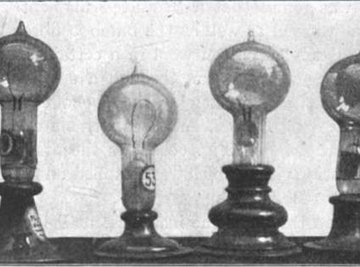
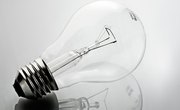
On January 27, 1880, Thomas Alva Edison was granted a patent for the electric light bulb, and for the first time in human history, man could conquer the night with the flip of a switch. Although over a hundred years has passed since that day, modern incandescent light bulbs are very similar to Edison's groundbreaking model. The same basic formula applies to both; Isolate a filament from oxygen and pass electric current through it to produce light.
Resistance and Incandescence
Although at first it might seem as if current flows through a conductor effortlessly, in the vast majority of circumstances this is not so. Almost all conducting materials provide some sort of impediment to the flow of current, a property called "electrical resistance." When electricity flows through a typical conductor, some of its energy is required in order to overcome the material's resistance. As a result, the conductor heats up, sometimes dramatically.
Such is the case with incandescence, the phenomena that is used to produce light from electricity. When a material reaches a sufficient temperature it begins to emit photons, which are perceived by the human eye as light. By choosing a material with a high electrical resistance and then applying sufficient current, enough heat can be produced in the conductor to result in incandescence, and thus light.
The Mechanics of Making Light
All light bulbs are essentially a specialized electrical circuit. Current flows into the bulb on one side, produces light, and flows back out the other. The filament, which is the piece of wire you can see if you look inside an unlit light bulb, is actually nothing more than a section of this circuit which has high electrical resistance. Edison's light bulb used a carbonized piece of bamboo as a filament, whereas most of his peer's models used a piece of metal wire, and innovation which gave his bulbs a life expectancy of over one thousand hours.
However, a filament and electrical current alone are not sufficient to make a light bulb. If enough oxygen is present inside the glass, the heat produced in the filament would quickly cause it to catch fire. In order to prevent this, it is necessary to create a vacuum inside the bulb itself.
The First Viable Light Bulb
Edison was not the first inventor to develop the idea for a light bulb by the methods outlined here. In fact, at the time of his patent grant, many of his peers had developed their own models almost as sophisticated as his own. Edison's model achieved prominence not because it was the first light bulb but because it was the first commercially viable light bulb. The innovation of a carbon filament along with superior methods for creating a vacuum resulted in a model that had sufficient longevity for practical use.
About the Author
As a freelance writer, Ethan Gallagher has worked for various websites and has been published on various online health and fitness publications. Gallagher is currently a student pursuing a degree in biochemistry and he hopes to research green technology after graduation.
Photo Credits
(Image retrieved from public domain)