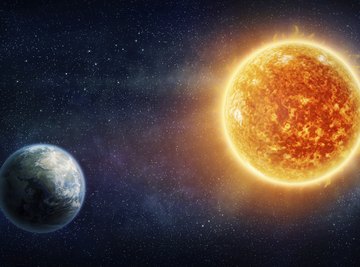

"I'd put my money on the sun and solar energy," Thomas Edison once remarked prophetically. The sun's potential to provide energy has been demonstrated throughout history. People in the 7th century, for example, used magnifying glasses to start fires. Even if you don't own technology that harnesses sunlight, you probably use products or services provided by companies that do.
Energy Courtesy of Sunlight and Sand
In 1839, French physicist Edmund Becquerel discovered the photovoltaic effect -- a process where solid material generates current when exposed to sunlight. In 1954, Bell Labs scientists used silicon, an element in sand, to create a silicon photovoltaic cell that produced current when light struck it. The Space Agency used these cells to power its Vanguard satellite's radio in 1958. As NASA continued using photovoltaic cells over the years, solar energy technology advanced as production costs declined. After the 1973 oil crisis, the Federal Photovoltaic Utilization Program resulted in the installation of over 3,000 PV systems.
Free Power When the Sun Shines
Homes, companies, farms and governments are some entities that use photocells to generate power. You may have seen solar panels, composed of multiple photocells, anchored to the roofs of local homes and businesses. Ten or twenty solar panels often power an average home where around forty cells make up a module. Some panels are on tracking devices that follow the sun, while others are stationary and face south. People in places powered by solar panels are free to use the electricity any way they like. You can purchase special batteries that store the energy that solar panels produce. These come in handy when the sun goes down and you need electricity.
Solar Energy at Work
Solar modules appear in diverse areas on Earth and above it; satellites and the International Space Station rely on them. Home builders may place photovoltaic cells in construction materials to help buildings generate electricity. Remote locations make ideal candidates for solar energy consumption. Oil and gas companies, for example, power wells and field equipment using light from the sun. In the oceans and waterways, you'll find lighthouses and buoys that use solar energy for power.
Become a Solar Energy Trivia Expert
You don't need the photovoltaic effect to use the sun's energy. Solar cookers focus and trap sunlight in containers that cook food without using fuel. Solar water heaters work by using tubes or panels to collect solar energy that heats the water. Companies and utilities that need large amounts of electricity can use solar arrays -- structures that consist of interconnected solar arrays. As of March 2015, Nellis Air Force Base, Nevada, was working on the Department of Defense's largest PV system. When completed, it will provide the base with 19 megawatts of power. Because silicon solar cells only produce energy using the sun's visible light, they don't take advantage of the infrared radiation the sun emits.
References
About the Author
After majoring in physics, Kevin Lee began writing professionally in 1989 when, as a software developer, he also created technical articles for the Johnson Space Center. Today this urban Texas cowboy continues to crank out high-quality software as well as non-technical articles covering a multitude of diverse topics ranging from gaming to current affairs.
Photo Credits
egal/iStock/Getty Images