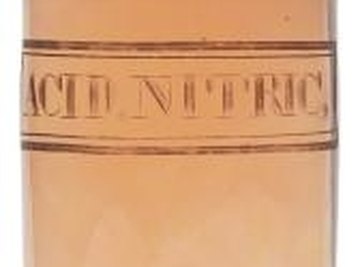

Sodium nitrate belongs to the family of compounds called salts, which are formed by uniting an acid (nitric in this instance) with a base (in this case sodium hydroxide). When sodium nitrate is combined with hydrochloric acid, an exchange reaction occurs, producing sodium chloride and nitric acid. The salt and nitric acid can be separated from each other and the two substances can be put to practical use.
The Reaction
In the symbols of chemical terminology, the reaction may be written:
NaNO3 + HCl ---> NaCl + HNO3.
This says that one molecule of sodium nitrate reacts with one molecule of hydrochloric acid to produce one molecule of sodium chloride and one molecule of nitric acid.
Sodium Chloride
One of the reaction products, sodium chloride, is readily available in nature, so this reaction is not a particularly useful source for that substance. Purified sodium chloride is ordinary table salt, and in its impure state (halite) is used for a variety of purposes, including (among many other things) winter road-conditioning and ceramic glazes.
Nitric Acid
While nitric acid can be produced commercially in a number of ways, many of those are too complicated for the amateur scientist. Apart from buying nitric acid, one of the easiest ways to make it is by the above chemical reaction. There are many important nitrates and nitro-compounds directly derivable from nitric acid.
Important Nitrates
Ammonium nitrate, an inorganic nitrate, is very important in agriculture as a fertilizer rich in nitrogen, since both the ammonium group (NH4+) and the nitrate group (NO3-) contain nitrogen. Other nitrates of special importance are potassium nitrate, strontium nitrate and barium nitrate. Barium nitrate is used to produce a green coloration in fireworks, and in the formation of some thermite (incendiary) formulations.
Organic Nitro-compounds
Organic nitro-compounds have the general formula R-NO2 (aliphatic) or Ar-NO2 (aromatic). Both may be formed utilizing nitric acid as a starting material. Many important nitro-compounds possess explosive properties. One of the more important is trinitrotoluene, or TNT. Another important explosive is nitroglycerine. Still another is nitrocellulose, or gun cotton. Cordite, a combination of nitrocellulose with nitroglycerine and a little Vaseline, was once used as a smokeless gas propellant in weaponry.
References
About the Author
Vincent Summers received his Bachelor of Science degree in chemistry from Drexel University in 1973. He furthered his education through the University of Virginia's Citizen Scholar Program program, taking many courses in organic and quantum chemistry. He has written technical articles since 2010.
Photo Credits
Hemera Technologies/PhotoObjects.net/Getty Images