Why Does Cream Turn Into Butter?

Why Does Cream Turn Into Butter? thumbnail
Butter is water-in-oil emulsion.

Cream contains fat and water molecules. When ripened and sheared, the fat particles combine to form an emulsion with some of the water particles. This emulsion is called butter. Does this Spark an idea?

  1. Emulsion

    • Cream is made up of fat particles suspended in water. When the cream is agitated, it is converted to an emulsion of water particles suspended in fat. The emulsion that occurs between the fat and water in cream causes butter to form.

    Ripening

    • Cream goes through two steps as it transforms to butter. First, the cream is ripened. In a commercial setting, cream is brought to the correct temperature in stages. At home, cream comes to room temperature. Ripening causes a membrane to form around the fat globules with a layer of crystallized fat particles behind the membrane.

    Shearing

    • Shaking the cream, a process known as shearing, breaks the membranes that hold the fat crystals. The fat crystals merge and form clumps. Further shearing causes more fat globules to join together and separate from the water and proteins left over after the fat has been removed. With continued shaking the fat globules form a single clump of butter. The aqueous portion that remains is buttermilk.

Related Searches:

References

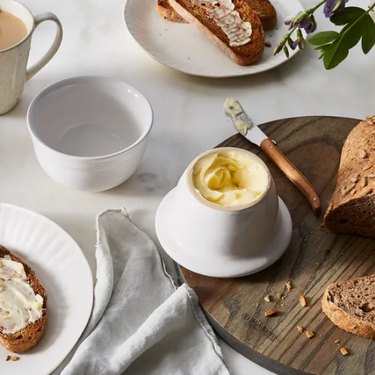
  • Photo Credit bread and butter image by Yuriy Rozanov from Fotolia.com

Comments

You May Also Like

Related Ads

Know Your Knives: Josh Ozersky’s Comprehensive Guide

I have a lot of knives. You probably do too. I really don’t know what to do with them all. There’s a Chinese cleaver, aï؟½

Featured