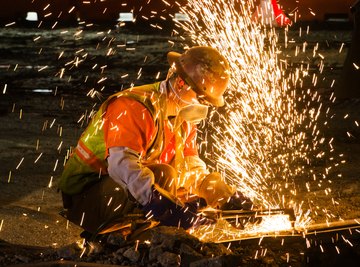
You have most likely noticed that the normal operation of everyday society depends strongly on solid metal structures: the beams in buildings and bridges, for example, and the steel found in movable elements such as airplanes and automobiles. But while the might and sheer solidity of steel and other heavy metals may be obvious, have you ever wondered how metal is joined together?
Apart from the screws that can bind everyday metal objects in place, other methods are needed to actually join metals – that is, change them into a form that in effect makes them the same object, with a joint that includes physical and chemical properties of both objects (if made of different materials at the joining position.)
Welding involves the joining of metal objects via heating them both at a junction until each of them melts, and having a fusion between them occur when the mixture cools and re-solidifies. Oxygen acetylene welding, or just oxy acetylene welding, is a famed example of the welding process.
- You have perhaps heard of soldering, which also involves binding metals together via heating. In the case of soldering, however, only the metal used as the junction is heated, while the joined metals are not. In this sense, soldering is more like using chewing gum than "joining."
A Brief History of Welding
Welding dates back at least 3,000 years. Evidence of welding in the Bronze Age is found in the form of 2,000-year-old circular gold boxes held together by extreme heating. Even before that, cultures in the Mediterranean had learned to weld iron and to make tools via this process, some of which date back to 1,000 B.C.
In 1836, Edmund Davy discovered acetylene, although its use in welding would not became widespread for another 70 years or so. The advent of the electrical generator in the middle and latter part of the 19th century paved the way for arc welding, which relies on an electrical spark, and for welding and cutting techniques involving gas.
In the 1880s, the first patents for arc welding, specifically carbon arc welding, were secured in the United States, and for the next several decades this was a popular form of the welding industry. The early 1900s saw rapid advances in the technology of the electrodes used in arc welding, along with the development of the field of resistance welding.
The 1920s saw the introduction of automatic welding machines. A decade later, the technique of stud welding was introduced, and it quickly found a powerful anchor in the shipbuilding industry, burgeoning at the time. Since then, more and more gases have been employed in welding, and plasma welding has become more popular in the early 21st century.
What Is Oxy Acetylene?
"Oxy acetylene" is actually a mixture, not a chemical compound in its own right. That is, you will not see a container of "oxyacetylene" sitting around. The term refers to the volatile mixture created for a specific purpose (superheating) from the combination of pure oxygen gas (O2) and acetylene gas (C2H2).
Acetylene, which consists of two carbon atoms triple-bonded to each other and to a single hydrogen atom each, is also known as ethyne. It is a colorless gas, and it may smell slighly pleasant. When heated, it is easily broken down into carbon and hydrogen, but this can cause explosions, and pure acetylene subjected to sufficient pressure (15 pounds per square inch or so, barely in excess of atmospheric pressure) can explode unprovoked.
Mixtures of air and acetylene are explosive to different degrees, depending on the percentage of air involved. But properly harnessed and modulated, this combustion can produce not only heat but light, and was used for this purpose in buoys and the like long ago. In an oxy acetylene welding device, the acetylene is combined not with air (which contains about 20 percent oxygen) but pure oxygen, resulting in the potential for extreme heat release.
The Physics of Welding
In the 1980s, a Massachusetts Institute of Technology (MIT) professor researched the physics and chemistry of welding in great detail. By this time, oxy acetylene welding had been around for over 80 years. It was known that the peak temperature achieved during the combustion of pure acetylene was well in excess of 3,000 degrees Celsius, or close to 6,000 degrees Fahrenheit. As it happens, this is the highest known temperature that can be reached using the combustion of any gas with oxygen.
The MIT paper underscored the practical limits of welding per se, so, despite the date of its publication, some of its findings remain timeless. One such practical limitation is in the surface of the materials to be welded; they can be made attractive to bonding and freed of contaminants only to a finite extent.
In addition, while the absolute temperature is vital, the time of exposure to maximum heat can supersede lower ceiling temperatures. So, while oxy acetylene welding sees temperatures climb to as high as 3,480 C, arc welding is more efficient because up to 50 percent of the heat created is theoretically available for welding, compared to only 10 percent for oxy acetylene welding.
The paper outlined other important considerations of a physical and chemical nature, which would not necessarily suggest that any one process is superior to another, but could help predict the behavior of newly introduced technologies. These include spark travel speed, the choice of specific surface area and the cost of equipment.
Oxygen Acetylene Welding Equipment
An inventor named Thomas produced the first oxy acetylene torch apparatus in 1903. This Thomas, however, was not Edison, who was busy inventing everything else at the time, but Wilson. Thomas Wilson used a mixture of "pure" oxygen (actually, 99.5 percent oxygen, as good as he could generate at the time) to produce a flame with a temperature hot enough to burn steel. To this day, oxy acetylene remains the only gas mixture with this capability, and it can even be used underwater.
In practice, oxy acetylene comes in different mixtures, not only the most potent one. This can be adjusted by the operator on the go, as the oxygen and the acetylene are, for obvious reasons, stored in different tanks. In the so-called neutral setting, the most common for welding, the mixture is about equal parts oxygen and acetylene. In the so-called oxidizing setting, used for cutting, the output of O2 gas into the mixture is increased, and in the carburizing setting, the acetylene flow is increased.
Despite the hazard associated with keeping these two gases close together, and with the independent hazards associated with storing acetylene (the dangers of which were outlined previously) and oxygen (explosive when exposed to a flame), the storage and transport of oxy acetylene welding equipment is easy. Acetylene, after all, is a small and lightweight compound, and its hazards are well-documented and hence well under control in any professional, supervised setting.
The equipment itself has two steel cylinders, one for each gas and both under pressure. These are equipped with hoses and control valves, and the piping ultimately leads to the part of the device you think of most when you think of welding – the blow pipe. Several safety devices prevent blowback in the direction of the operator.
References
About the Author
Kevin Beck holds a bachelor's degree in physics with minors in math and chemistry from the University of Vermont. Formerly with ScienceBlogs.com and the editor of "Run Strong," he has written for Runner's World, Men's Fitness, Competitor, and a variety of other publications. More about Kevin and links to his professional work can be found at www.kemibe.com.