All living things are made up of cells. Some of the smallest organisms, such as yeast and bacteria, are single-celled organisms, but most plants and animals are multicellular. While both plants and animals are made up of cells, the two types of cell are markedly different in ways that can be readily observed. Many of the differences between plant and animal cells are visible under a microscope, and it's relatively straightforward to distinguish between the two.
TL;DR (Too Long; Didn't Read)
Plant cells have cell walls, one large vacuole per cell, and chloroplasts, while animal cells will have a cell membrane only and several smaller vacuoles. Animal cells also have a centriole, which is not found in most plant cells.
Cell Walls
All plant cells have cell walls made of cellulose -- this is a defining factor for plant cells. Under a microscope, plant cells from the same source will have a uniform size and shape. Beneath a plant cell’s cell wall is a cell membrane. An animal cell also contains a cell membrane to keep all the organelles and cytoplasm contained, but it lacks a cell wall. Microscopically, animal cells from the same tissue of an animal will have varied sizes and shapes due to the lack of a rigid cell wall.
Vacuoles
Both plant and animal cells contain vacuoles, which are organelles that store waste materials, nutrients and water. The difference between plant and animal vacuoles is that plants have one large vacuole enclosed by a membrane and animal cells have many, smaller vacuoles. The vacuole in a plant cell will often take up nearly 90 percent of the cell’s volume.
Chloroplasts
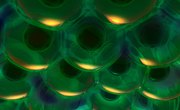
Chloroplasts are required to carry out photosynthesis. Because only plant cells perform photosynthesis, chloroplasts are found only in plant cells. They are green in color under a microscope because they contain chlorophyll, a naturally green pigment. One of the quickest ways to differentiate between a plant and animal cell is to look at the unstained cell under the microscope. If green organelles are present, it is a plant cell.
Centriole
A centriole is a cell structure found in most animal cells. While it is found in some lower plant forms, most plants lack this barrel-shaped structure. It is typically composed of nine sets of three microtubules, which are proteins that make up the cytoskeleton of the cell. The centriole aids in the organization of the mitotic spindle, the structure that separates the chromosomes during cell division. It is also imperative during a process known as cytokinesis, during which the cell divides its cytoplasm between the two newly formed daughter cells at the end of mitosis and meiosis. If a barrel-like structure is visible in the cell through the microscope, chances are the cell is an animal cell, unless green organelles are visible as well. This would indicate a lower plant cell.
References
About the Author
Jack Powell has been writing professionally since 2008. He graduated from Red River College with a degree in creative communications and currently writes for a variety of local publications.