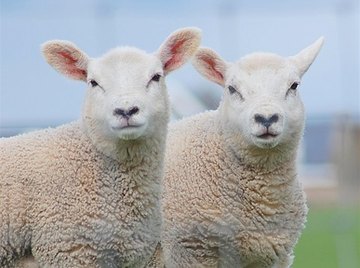

The word homogeneous is used in many disciplines to mean different things, but they all apply the word to some characteristics that are alike. The meaning of homogeneous is based on the Greek word "homo," which means "same." For example, in math, linear equations that equal zero are homogeneous equations. In statistics, information based on data from one source is homogeneous. Populations that have mostly the same characteristics are homogeneous, and the universe is homogeneous if different directions have the same properties.
In science, the most common use of homogeneous is to classify materials. Mixtures, substances and solutions can have different characteristics, and their homogeneity gives clues about how they will behave. This is one of the most important scientific uses of the term.
TL;DR (Too Long; Didn't Read)
The word "homogeneous" is based on the Greek word "homo," which means "same." It is used in many disciplines to characterize features that are alike, but one of the most important scientific uses is to classify materials. In a homogeneous mixture, one part of the mixture is exactly the same as any other part. If the different parts have a different composition, the mixture is heterogeneous.
Classifying Homogeneous vs Heterogeneous Materials
Most common materials are mixtures of several substances or a single substance with varying degrees of purity. For example, air is a mixture of nitrogen, oxygen and carbon dioxide, but there are always many other impurities in air. Water is a single substance with the chemical composition H2O, but water usually contains traces of contaminants. Salad dressing is a mixture of oil, vinegar and other substances. All of these mixtures can be classified as either homogeneous or heterogeneous. Such a classification is important because homogeneous mixtures are hard to separate into their components while heterogeneous mixtures separate easily. For research purposes or industrial processes, the type of mixture used can make a big difference to the processes that have to be used and the costs.
Characteristics of a Homogeneous Mixture
The substances of a homogeneous mixture combine completely on a molecular or microscopic particle level, but they don't form any chemical bonds. Common homogeneous mixtures are solutions, which are characterized by the fact that the substances in solution don't separate out over time. Heterogeneous mixtures in liquids tend to settle out, such as silt in water. Sugar dissolves in water, forms a homogeneous solution and doesn't settle out.
While solutions such as sugar in water are homogeneous and have the same concentration throughout, the concentration of two different solutions can vary a lot. Some solutions only have a tiny bit of solute in the solvent and are diluted while others have lots of solute and are concentrated or saturated. In the case of heterogeneous mixtures, the concentration between two mixtures can vary as well, but it can also vary within the mixture itself.
The heterogeneity of a mixture makes it easy to separate into components. For example, parts of a heterogeneous mixtures can be skimmed off, put through a sieve or strained through a cloth. None of these methods work with homogeneous mixtures and solutions. instead, physical or chemical processes have to be used. For example, water can be distilled, which means boiled and condensed. Any sugar or other solute in the water is left behind. Air is a homogeneous mixture, but oxygen can be removed by combustion. Although the homogeneous mixtures are hard to separate because they look uniform, physical and chemical processes can do the job.
References
About the Author
Bert Markgraf is a freelance writer with a strong science and engineering background. He has written for scientific publications such as the HVDC Newsletter and the Energy and Automation Journal. Online he has written extensively on science-related topics in math, physics, chemistry and biology and has been published on sites such as Digital Landing and Reference.com He holds a Bachelor of Science degree from McGill University.
Photo Credits
Twin Lambs image by Zen Photography from Fotolia.com