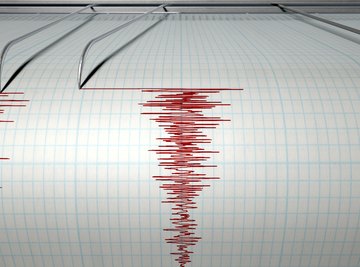
There are two primary scales used to measure earthquakes: the Richter scale and the Mercalli scale. The Richter scale is most common in the United States, while worldwide, scientists rely on the Mercalli scale. The moment magnitude scale is another earthquake measurement scale used by some seismologists. All three scales provide useful information in measuring and analyzing earthquakes across the globe.
The Richter Scale
The Richter scale was invented in the 1930s by Dr. Charles Richter, a seismologist at the California Institute of Technology. A Richter magnitude is calculated based on the amplitude of the largest seismic wave recorded for the earthquake. The Richter scale is a base-10 logarithmic scale, meaning that there is no limit to how small or large the earthquake must be to be measured by the scale. The Richter scale runs from 1 to 10, with 1 being the smallest and 10 being the largest. Because the Richter scale is logarithmic, a 5.0 earthquake measures 10 times the shaking amplitude than one that measures 4.0, for example.
The Mercalli Scale
The Mercalli scale measures the intensity of an earthquake by quantifying the effects of an earthquake on the Earth's surface. Based on human reactions, natural objects and man-made structures, the Mercalli scale rates earthquakes on a scale of 1 to 12, with 1 denoting that nothing was felt and 12 denoting total destruction. Invented in 1902 by Giuseppe Mercalli, the Mercalli scale isn't considered as scientific as the Richter scale. This is because the Mercalli scale relies on witnesses to report about the earthquake, so the quake's force is not defined in rigorous and objective standards, as the Richter scale provides.
Moment Magnitude Scale
The moment magnitude scale was introduced in 1979 as a successor to the Richter scale. The moment magnitude scale compares energy released by earthquakes and is based on the moment of the earthquake, which is equal to the rigidity of the Earth multiplied by the average amount of slip on the fault and the size of the area that slipped. The moment magnitude scale is more accurate in measuring large earthquakes than the Richter scale and is used to estimate magnitudes for all modern large earthquakes by the U.S. Geological Survey.
References
About the Author
Ariel Phillips is an editor and writer living in Portland, Ore. He has written for "n+1 Journal" and "The Rumpus Magazine," among others. He maintains an interest in a variety of subjects, including art, culture, the environment, media, the sciences and sports. He earned bachelor's degrees in art and philosophy from the University of California, Santa Barbara.
Photo Credits
allanswart/iStock/Getty Images