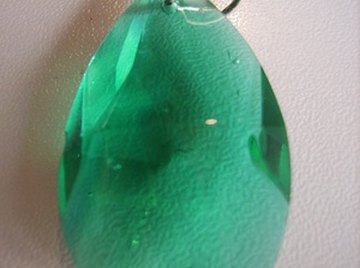

Synthetic emeralds, also known as “created” or “lab” emeralds, are very similar to real emeralds since both gems are of the same mineral and share the same chemical makeup. However, synthetic emeralds are artificially created in a lab, while real emeralds are grown when the natural forces of the Earth apply heat and pressurize organic material to form the precious stones. Real emeralds tend to be more “milky” and opaque than their synthetic counterparts. Synthetic emeralds share the physical characteristics of natural emeralds, but they are more vibrant and tend to cost less than one 10th the price of a natural emerald.
- Rotating, gold-lined pressurized chamber
- Platinum wire
- Hydrochloric acid
- Natural yellow beryl seed
Amounts of chromium, iron, and nickel cause the gem's characteristic chevrons and growth lines. Impurities from chromium and vanadium give the gem its green color. However, these features may not be visible initially .
The hydrothermal process of synthesizing emeralds is very expensive and energy intensive, and it is difficult to successfully yield results due to a slow process of development. Emeralds grow only a fraction of a millimeter per day, so it can often take up to a year before their crystals are fully formed.
Pressurize gem constituents in a rotating, gold-lined and airtight chamber at about 450 degrees C.
Suspend a natural yellow beryl seed using a platinum wire to initiate growth.
Add a solution of highly concentrated hydrochloric acid to prevent the chromophore (the part of a molecule that gives it its color) from precipitating.
Wait 40 to 60 days for large crystals of synthetic emerald to form. (Note that these crystals may continue to grow for months.)
Things You'll Need
Tips
Warnings
References
Tips
- Amounts of chromium, iron, and nickel cause the gem's characteristic chevrons and growth lines. Impurities from chromium and vanadium give the gem its green color. However, these features may not be visible initially .
Warnings
- The hydrothermal process of synthesizing emeralds is very expensive and energy intensive, and it is difficult to successfully yield results due to a slow process of development. Emeralds grow only a fraction of a millimeter per day, so it can often take up to a year before their crystals are fully formed.
About the Author
Audrey Farley began writing professionally in 2007. She has been featured in various issues of "The Mountain Echo" and "The Messenger." Farley has a Bachelor of Arts in English from the University of Richmond and a Master of Arts in English literature from Virginia Commonwealth University. She teaches English composition at a community college.
Photo Credits
emerald image by Barcabloo from Fotolia.com