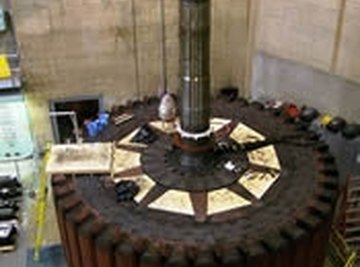
Motors and generators are electromagnetic devices. They have current-carrying loops that rotate in magnetic fields. This rapidly changing magnetic field produces electromotive forces, called emfs or voltages. Electric motors and generators are the opposite of each other. Electric motors convert electrical energy into mechanical energy, while electric generators convert mechanical energy into electrical energy.
Construction
Electric motors and generators have current-carrying loops that continuously rotate in a magnetic field. The loops are wrapped around an iron core called an armature that makes the magnetic field inside of them stronger. The current in the loops reverses direction causing the armature and hence the loops to constantly rotate. The changing direction of the loops causes an induced emf to be generated.
Emf is short for electromotive force. It is not a force, but is the potential difference between the terminals of a device that changes one form of energy into electrical energy. A battery, for example, converts chemical energy into electrical energy, and so is a source of emf. A potential difference is a voltage.
The induced emf created by the motion of the loops becomes larger the more rapidly the magnetic field changes. This is Faraday's Law of Induction, named after its discoverer, renowned physicist Michael Faraday.
AC Generators
AC generators are opposite from motors, because they convert mechanical energy into that of electrical. Mechanical energy is used to rotate the loops in the magnetic field, and the generated emf is a sine wave that varies in time. Steam made from burning fossil fuels such as coal, oil and natural gas is a common source in countries like the United States. In Europe, nuclear fission is used to create steam. In some hydroelectric plants, such as those found at Niagara Falls, water pressure is used to rotate the turbines. Turbines are rotors with vanes or blades. Wind and water are not commonly used as fossil fuels for mechanical energy sources because they are not as efficient and are more costly.
AC Motors
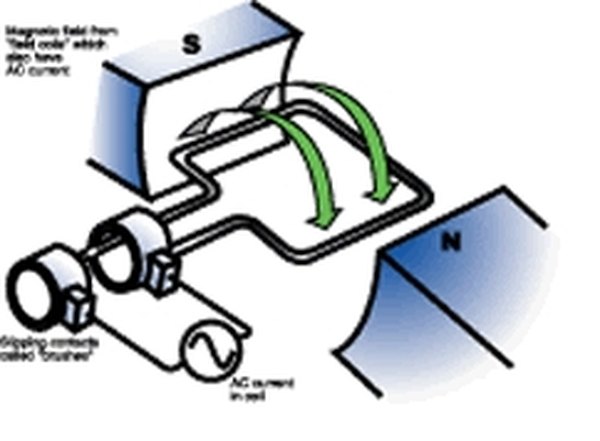
AC motors convert electrical energy into that of mechanical. An alternating current is used to rotate the loops in the magnetic field. Most AC motors produce the current by using induction. An electromagnet causes the magnetic field and uses the same voltage as the coils do.
DC Motors and Generators
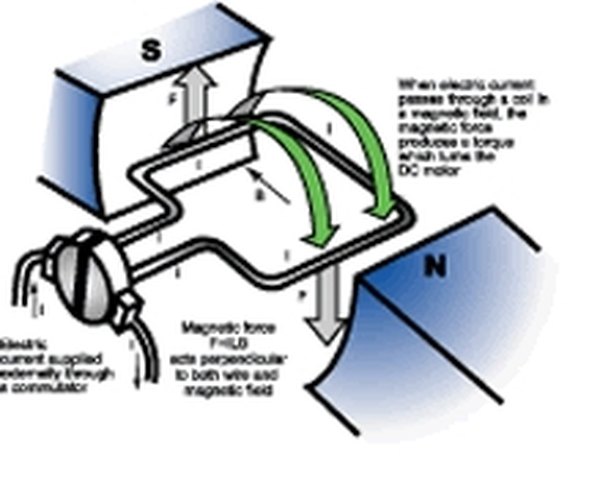
DC motors and generators are similar to their AC counterparts, except that they have a split ring called a commutator. The commutator is attached to electrical contacts called brushes. The changing direction of the current through the commutator causes the armature and thus the loops to rotate. The magnetic field the armature turns in may be a permanent magnet or electromagnet. DC generators have a generated emf is direct current.
Motors Compared to Generators
All motors are generators. The emf in a generator increases its efficiency, but an emf in a motor contributes to energy waste and inefficiency in its performance. A back emf is a resistance to change in a magnetic field. A back emf appears in a motor after it has been turned on, though not immediately. It reduces the current in the loop, and gets larger as the speed of the motor increases.This causes the power requirements of the motor to also increase, especially under loads that are very large.
About the Author
Kim Lewis is a professional programmer and web developer. She has been a technical writer for more than 10 years and has written articles for businesses and the federal government. Lewis holds a Bachelor of Science, and occasionally teaches classes on how to program for the Internet.
Photo Credits
Jarek Tuszynski