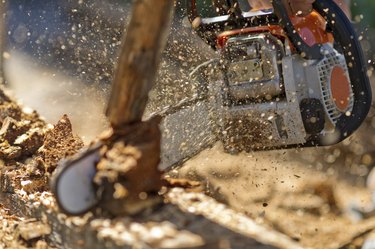
Four-cycle engines are the most common internal combustion engines, but many smaller machines, such as lawn mowers, weed whackers and chain saws, have 2-cycle engines. As far as the user is concerned, the difference is that you add oil directly to the gas of your 2-cycle tool, while you pour oil into a separate port with a 4-cycle engine. Because it burns with the fuel, 2-cycle oil is lighter and contains additives for better combustion.
Small Engine Basics
Video of the Day
All internal combustion engines operate by the same principle: A piston moves up and down in a tight-fitting cylinder, powered by the explosion of fuel. A mixture of fuel and air enters the combustion chamber, and when the spark plug ignites it, the explosion forces the piston down. The piston is connected to a drive shaft that powers whatever the engine is operating, and the spinning of a flywheel connected to the drive shaft forces the piston back up until the next spark plug ignition begins the next cycle. The main difference between a 2-cycle and 4-cycle engine is in the complexity of the piston movement.
Video of the Day
2-Cycle vs. 4-Cycle Engines
The piston in a 2-cycle engine is notched, and the cylinder has strategically placed ports. Together, these allow the combustion gases to be expelled on the downstroke of the piston, so the plug can fire the next time the piston is at the top of its cycle. In a 4-cycle engine, exhaust gases are expelled through valves at the top of the piston chamber with each alternate movement of the piston, which means the piston must execute two complete cycles each time the plug fires. Two-cycle engines generate more power and are easier to build, but 4-cycle engines run more smoothly and cleanly.
Lubricating Small Engines
Both types of engines generate extreme heat, and without lubrication, the metal parts would fuse and the engine would seize. Because of its simple construction, a 2-cycle engine has no separate oil circulation system, and you must add the oil directly to the fuel. Oil burns up in the combustion chamber along with the fuel. A 4-cycle engine, however, has a circulating pump that keeps oil flowing through the engine while the piston is moving; this oil returns to the crankcase and gets recycled indefinitely. If all the seals are tight, the engine never loses oil, but it gets contaminated with metal particles and combustion byproducts, and you must replace it periodically.
2-Cycle and 4-Cycle Oil
Because 2-cycle oil burns with the fuel, it must be more refined than 4-cycle oil, and it must contain a number of additives. These include detergents to clean varnishes and carbon deposits from the combustion ports, anti-wear agents to protect moving parts, biodegradability components and antioxidants. Four-cycle oil also contains additives, but the oil isn't designed to burn, so the additives are of a different quality. In a pinch, you may be tempted to run a 2-cycle engine by adding 4-cycle oil to the gas, but according to a lawn and garden equipment article published by the University of Tennessee Agricultural Extension Service, you should never mix 4-cycle oil with gasoline in a two-cycle engine, which would damage the engine and significantly shorten its life. You should also avoid using 2-cycle oil in a 4-cycle engine as it's too thin and may permanently damage the engine.