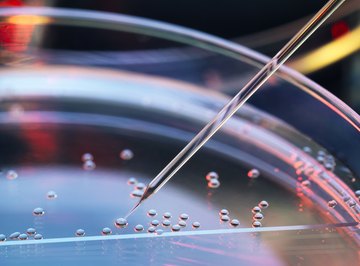

Advances in stem cell research offer hope to patients suffering from diseases and life-threatening ailments with no known cure. The special regenerative properties of embryonic stem cells give them the power to repair and replenish cells in the body. Scientists are studying how stem cell therapy could be used to restore functioning in damaged cells, tissues and organ systems.
What Is an Embryonic Stem Cell?
Most cells in the human body are immutable and highly specialized. By contrast, all embryonic stem cells have the extraordinary ability to differentiate into any of the hundreds of specialized cells that comprise the human body. Harvested stem cells continue dividing in the lab for an extended period of time, providing an ongoing supply for research purposes. A small stem cell population can proliferate into millions of cells within months, according to the National Institutes of Health.
Embryonic vs. Adult Stem Cell
Three to five days after conception, a blastocyst forms. Under the right conditions, embryonic stem cells in the blastocyst have the capacity to become brain cells, nerve cells, skin cells, blood cells and more. Researchers use embryos from fertility clinics given by donors for research purposes.
Adults possess a small number of stem cells in certain tissues, which can repair specific types of cells. For instance, adult hematopoietic stem cells in bone marrow regenerate blood cells; but, hematopoietic cells can’t make new nerve cells. Scientists are studying the possibility of manipulating adult stem cells in the lab to make them more versatile.
An advantage of embryonic stem cells is that they are in better condition than adult stem cells. Somatic and stem cells in adults may have mutations from repeated division and exposure to environmental pollutants.
Read more about the structure of stem cells.
Is Stem Cell Research Beneficial?
The International Society for Stem Cell Research (ISSCR) suggests that stem cell therapies could help with treating many diseases and injuries. The ISSCR notes that “thousands of children” diagnosed with leukemia have been helped by blood stem cell treatments. Stems cells are also being used successfully for tissue grafts.
Stem cell research leads to safer and more effective stem cell therapies. A deeper understanding of how embryonic stem cells respond to different conditions could advance the study and treatment of birth defects, for example. The Mayo Clinic supports continued stem cell research because of the many advantageous ways that clinical trials further the medical field. Potential benefits include:
- Observing how stem cells mature into organs and tissues provides scientists with insight into the etiology and progression of disease.
- The pros of stem cell research include advancing the field of regenerative medicine. Stem cells have the power to repair and replace damaged cells.
- Stem cells could possibly be cultured in a lab to grow new organs for people awaiting transplants.
- New drugs can be tested for effectiveness and safety using stem cells. For example, stem blood cells could be used to test a new drug intended to treat blood-related diseases. Researchers could also identify any deleterious effects on blood cells being used in lab studies.
How Does Stem Cell Therapy Work?
Stem cell therapy helps the body heal itself. Most cells in the human body have a very specific job to do within a particular organ. If cells die or malfunction, the body is capable of replenishing lost cells. Illness, organ failure and death can occur if the number of diseased and dying cells surpasses production of new cells.
Read more about the explanation of cell specialization.
Normal cells replicate many times over. Scientists are refining techniques that can jump-start healthy cell production. For example, implanting normal pancreatic cells into a patient with diabetes could restore the ability to produce insulin as the cells multiply.
Benefits of Embryonic Stem Cell Research
Embryonic stem cells are pluripotent, meaning they are more versatile in research studies than adult stem cells. The potential benefits of embryo research include discovering new ways of treating diseases, injuries and organ failure. Embryonic stem cells can be manipulated in the lab to develop into any type of cell in the body. Embryo research helps scientists understand how to prevent injected stem cells from growing abnormally and causing tumors.
Ethics of Embryo Research
The use of human embryos for stem cell research has been vigorously discussed and emotionally debated. Destroying human embryos is a commonly raised concern, often based on religious beliefs. The Genetic Science Learning Center notes that embryonic stem cell research poses both moral and ethical questions, such as:
- Does life begin at the moment of conception?
- Should a blastocyst be considered human?
- Is embryonic stem cell research justified if it may save lives of dying patients?
Opponents of embryonic stem cell research argue that embryos have rights because they hold the capacity to develop into a human being. However, the Hastings Center points out that 75 to 80 percent of embryos do not implant in the uterus and that many embryos from fertility clinics are poor quality and not capable of developing into a fetus. Also, donated embryos were scheduled for destruction before the donation was made.
Research Alternatives to Embryonic Cells
Human embryonic stem (hES) cells are vital to stem cell research because, as previously mentioned, hES cells are pluripotent, unlike other cells in the body. However, scientists are learning how to create induced pluripotent stem (iPS) cells from adult stem cells. Moreover, progress is being made in how to use a patient’s own stem cells to treat diseases. Alternatives to hES cells may reduce use of human embryonic stem cells.
Perinatal stem cells are another option. Perinatal stem cells have been discovered in umbilical cord blood and in amniotic fluid drawn during an amniocentesis procedure. More research is needed to determine how perinatal stem cells could be used in experimental studies and treatment.
Pros of Stem Cell Research
According to the American Association of Neurological Surgeons, the pros of stem cell research include helping millions of people who suffer from debilitating conditions. For instance, stem cell therapies could potentially increase dopamine in the brains of those afflicted with Parkinson’s disease. Stem cell research could also help restore functioning for patients with diabetes, heart disease, stroke, cancer, spinal cord injuries, osteoarthritis, Alzheimer's and degenerative diseases like amyotrophic lateral sclerosis (ALS).
Risks of Stem Cell Therapy
The U.S. Food and Drug Administration urges caution before participating in stem cell clinical studies or treatments not approved by the FDA. Claims that stem cell therapies offer a miracle cure are overstated, according to the FDA. Several adverse reactions are possible from emerging therapies that are relatively untested. For instance, in 2016 the FDA was informed of a patient who went blind after receiving an injection of stem cells for an eye condition.
Other FDA examples include:
- Injected stem cells may move away from the injection site and morph into an unanticipated cell type.
- Stem cells do not always mature as expected in experimental trials.
- Tumors can develop following stem cell therapy.
- The patient’s immune system may attack the transplanted stem cells. Even if the cells are from the patient’s own body, as in an autologous transplant, there can be complications. The process of manipulating, removing and returning stem cells can introduce bacterial contamination and cause illness or abnormalities.
Politics of Embryonic Stem Cell Research
Societal opinions on ethical issues related to rapidly advancing technologies like cloning and stem cell research influence public policy and government regulations. Former presidents of the U.S. have taken a political stance on the issue and changed regulations to align with the position of their political party. As of 2019, federal funding is available to fund embryonic stem cell research using new lines of cells. Previously, federal funding was limited to studies using a small number of existing embryonic cell lines.
References
- A Closer Look at Stem Cells: Nine Things to Know About Stem Cell Treatments
- American Association of Neurological Surgeons: Stem Cell Research
- U.S. Food and Drug Administration: FDA Warns About Stem Cell Therapies
- Genetic Science Learning Center: The Stem Cell Debate: Is It Over?
- The International Society for Stem Cell Research: About Stem Cells
- The Hastings Center: Stem Cells
- Mayo Clinic: Stem Cells: What They Are and What They Do
About the Author
Dr. Mary Dowd studied biology in college where she worked as a lab assistant and tutored grateful students who didn't share her love of science. Her work history includes working as a naturalist in Minnesota and Wisconsin and presenting interactive science programs to groups of all ages. She enjoys writing online articles sharing information about science and education. Currently, Dr. Dowd is a dean of students at a mid-sized university.