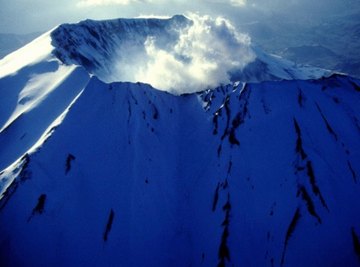

Mount St. Helens is an active volcano located in southern Washington state. Its most famous eruption on May 18, 1980, killed 57 people, destroyed 250 homes, and caused billions of dollars worth of damage. It was the most destructive volcanic event in American history. Fortunately, however, there was a great deal of activity in the months before the eruption. Nearby communities, as well as the rest of the nation, had plenty of warning that a major eruption was coming.
Early Concerns
In the area of the Cascade Range, a small continental plate, the Juan de Fuca Plate, pushes underneath the edge of the North American Plate. As a result, this area of the coast has experienced earthquakes and volcanic activity for thousands of years. Mount St. Helens had been visibly active as late as 1857, when the lava dome known as Goat Rocks was created on the north side. By the 1950s, as the area's geology came to be better understood, scientists realized that something was likely brewing beneath the surface. Studies published in 1975 and 1978 strongly suggested the volcano might erupt before the end of the century.
First Stirrings
Beginning about March 16, 1980, a series of small earthquakes occurred in the Cascades. Other than geologists, few people noticed. However, on the afternoon of March 20, 1980, a magnitude 4.2 earthquake rocked the state. Earthquake activity increased over the next few days, along with a continuous shaking called "volcano tremor." Geologists see this as a sign of magma moving underneath the volcano. Eventually, a large explosion was seen at the summit. This created a new crater, and it blew ash over a wide area. The mountain ejected steam and other material until about April 21.
Short Reprieve
The eruptions largely stopped between April 21 and May 16. During this time, however, the earthquakes continued; and, most dramatically, the northern face of the mountain began to swell visibly. This "bulge" grew rapidly for several weeks. By mid-May, parts of the north face were 450 feet higher than before the activity began. At one point, the bulge grew at the rate of 5 feet per day. The enormous pressure of the magma within the mountain was literally tearing it apart. The heat melted ice off the mountain in streams, and groundwater boiled away in some places. By this time, most of the country was aware that a major eruption could be near, and many people monitored the situation on national news programs.
Catastrophe
At 7 a.m. on May 18, a geologist radioed in a set of laser measurements of the north face. Nothing appeared to have changed. At 8:32 a.m., however, a magnitude 5.1 earthquake a mile below the mountain caused the unstable bulge to collapse. Within seconds, the entire northern side of the volcano fell away in a massive landslide, exposing the magma at its core and releasing the pressure. Mount St. Helens burst forth with an enormous explosion of rock and ash that expanded at nearly the speed of sound. In all, the eruption devastated over 200 square miles and dropped ash over much of the northwestern United States.
References
About the Author
Brian Kadigan is a professional writer for various websites. He has a lifelong interest in technology, history, the hard sciences and the role of information in culture. Kadigan holds a master's degree in library and information science and has worked primarily in the legal field in research and filing positions.
Photo Credits
NA/Photos.com/Getty Images