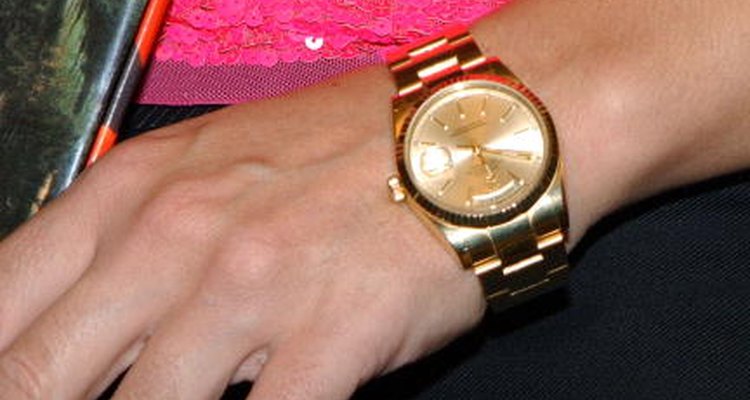
A Rolex watch makes a statement. A beautifully crafted timepiece, a Rolex is expensive, fashionable and says you've "arrived." But what to do when you want to arrive on time and your Rolex is slow? Moving up the minute hand every month or two wasn't in the game plan when you bought this expensive machine. A Rolex watch should be running within an accuracy of -4 to +6 seconds per day. If yours isn't, there are a few things you can do to get your watch up to speed.
Have your Rolex professionally cleaned by a watchmaker if it's more than five years old. Oil can dry up, and the watch will not keep time as perfectly as it should. Have the battery checked; it may need to be replaced.
Lay the watch flat and face-up every night. This will gain a few seconds every day.
Wind up your Rolex a full 45 to 50 turns and check time again over a day or two. This may jump start your Rolex into speeding up.
Have your watch regulated if all else fails. A watchmaker can adjust a Rolex using a timing machine. Rolexes have adjustable mass balances -- small weights that are either screws on the outside or nuts on the inside -- that can be adjusted to move the speed of oscillation.
Related Articles

How to Reset a Polar F6 that is Locked ...
How to Adjust a Rolex Submariner

How to Change the Battery in a Lassale ...
Instructions for the Functions of an ...
How to Manually Wind a Tag Heuer ...
How to Set a Rolex Day-Date

How to Evaluate Invicta Watches
How to Adjust a Kenneth Cole Wrist Band
How to Set the Date and Time on a Rolex ...

How to Change the Time on Tissot Watches
How to Set a Bulova Watch
How to Advance the Date on a Tag Watch

How to Set the Date on an Omega ...
How to Change the Date on a Luminox 3080
How to Change the Date & Time on a ...

How to set the Alarm on Your Pulsar ...
How to Fix a Stopped Rolex Submariner
Marc Ecko Watch Instructions
My Citizen Eco Drive Watch Has Stopped
How to Set a Citizen WR100 Watch
Writer Bio
Cindy Lobert has been a professional writer since 1986. While her background is primarily in advertising copywriting, she has also published work for national magazines such as "Women's World" and "Louisiana Life." Lobert graduated from Michigan State University with a Bachelor of Arts in communications.
Photo Credits
Mark Mainz/Getty Images Entertainment/Getty Images