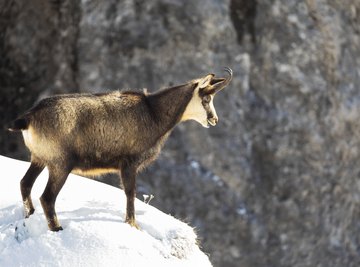

Adaptations are those differences that appear in a subset of individuals of a plant or animal species that turn out to improve their survival chances in a specific environment.
Those individuals, therefore, tend to produce more successful offspring for that environment. These changes may be physical, behavioral or both.
Plant and animal adaptations are the essence of survival and evolution. All living species of plants and animals have adapted over time in response to conditions.
Animal Adaptations
Animal adaptations may be physical or behavioral, or a combination of the two. Physical adaptations to the environment can be seen in such things as ear size or coat color in arctic versus desert animals such as foxes or rabbits.
Animals with useful traits that help them survive in their environment are the animals that survive to have offspring, to which they tend to pass down the successful trait. The offspring with the trait again will tend to be more successful than their siblings without it.
A trait must be used to be considered an adaptation. Leftover features from an earlier adaptation sometimes are seen and are considered "vestigial" traits. If they do not contribute to survival, such traits will disappear in the species over time, because they either don't matter or have become detrimental.
Another way in which animals adapt is through behavioral adaptation, in which a changed behavior contributes to improved survival and is handed down to offspring of the survivors.
Examples of Animal Adaptations
Examples of physical adaptations are evident in the organs of animals; natural selection does not retain superfluous organs.
One example of adaptation is the lungs of mammals being adapted explicitly for breathing on dry land, while fish have gills adapted for breathing in water. these two types of organs are not interchangeable.
An example of behavioral adaptation is seen in domesticated animals (such as dogs, horses or dairy cows) that allowed them to take advantage of beneficial associations with humans.
Animal Reproductive Strategies
Species also have adaptive reproductive strategies: Subarctic bees, for example, produce offspring at a much faster rate than temperate zone bees, because bees in the subarctic zone do not live as long.
Some animals such as sawtooth sharks, bees, wasps, ants and the New Mexico whiptail lizard can reproduce via a process called parthenogenesis, which is when the female produces offspring from eggs unfertilized by a male. These offspring are genetically identical to her and often produced as a response to a lack of males in her environment.
Some female animals such as the brown banded bamboo shark, many birds, fish, amphibians, invertebrates including dragonflies and some species of bats are capable of sperm storage for long periods. Sperm storage gives them the advantage of being able to mate when males are available, mate with multiple partners for sperm competition and produce their offspring when environmental conditions are right. Depending on the species, females can store sperm for days, months or even years.
Plant Adaptations
Although they lack a central nervous system that responds to its environment in the same fashion as animals, plants nonetheless make behavioral adaptions as well as physical adaptations. Plant adaptations are not more rudimentary than animal adaptations.
If anything, plant adaptations can be more sophisticated, as they are often more attuned to the plant's specific environment. Individual plants can't pick up and leave. They either manage to survive in place and produce offspring, or they don't.
Physical adaptations of plants generally fall into two categories: reproductive adaptations and structural adaptations.
Examples of Plant Adaptations
Plants have made a variety of reproductive adaptations to ensure the spreading and survival of their seed.
A common example is the bright colors of many flowers. The purpose of this adaptation is to draw specific insects and birds that will visit the plant and distribute its pollen when they move on to the next plant.
Structural adaptations allow plants to live in specific environments, as is seen in the stark contrast between the roots of terrestrial plants, which are firmly rooted in the ground, and plants that float on the surface of bodies of water.
Another structural plant adaptation example is the leaves of coconut and palm trees. Tropical islands are prone to wind events such as cyclones. By having thin leaves, they are less likely to be damaged in wind events.
An example of a behavioral adaptation in plants is how certain desert plants have developed opportunistic behaviors that allow them to spring from dormancy to sudden reproductive activity during times of moisture and cool temperatures.
References
- Coastal Carolina University: Plant Adaptations
- All You Need is Biology: The Great Journey of the Coconut
- Encylopaedia Britannica: Parthenogenesis
- Smithsonian: Meet Eight Species That Are Bending the Rules of Reproduction
- Reproduction in Domestic Animals: Mechanisms of Sperm storage in the Female Reproductive Tract: An Interspecies Comparison
- Spermatogenesis: Oh, the places they'll go: Female Sperm Storage and Sperm Precedence in Drosophila Melanogaster
Resources
About the Author
Drew Lichtenstein started writing in 2008. His articles have appeared in the collegiate newspaper "The Red and Black." He holds a Master of Arts in comparative literature from the University of Georgia.