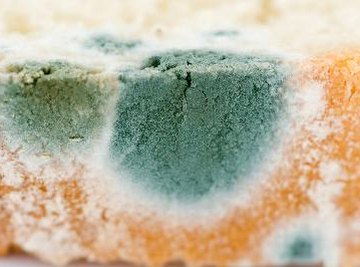
If you've ever pulled an orange out of the fridge, only to find the fruit mushy and covered in a hairy or splotchy green substance, you've encountered mold. It's possible that you've encountered similar growths in other areas as well: On cardboard left outside for days after a rain storm, on plants and in basements after they've flooded. These growths were mold as well – even if they came in different colors, like white, orange or pink. The wide range of colors may confuse you, but mold is fairly simple to understand: While there are some differences between white mold, green mold and purple mold, at the end of the day they're all types of fungi.
TL;DR (Too Long; Didn't Read)
"Mold" is a general term, used to refer to a wide range of fungi that grow in humid environments. Mold can develop indoors and outdoors, on anything from food to the structural supports of your home. Mold colors vary wildly, depending on the species of fungus native to your region. Two of the most common variants are green mold, often found on citrus fruit and bread – and white mold, which is commonly found growing on plants, in basements and on surfaces like drywall.
A Rainbow of Mold Colors
When something is referred to as "mold," a general term is being used any one of thousands of different species of fungus. Molds are a type of fungus found all over the world, that grow through the use of hair-like cell chains called hyphae and spread by using tiny spores. Mold spores literally exist everywhere, indoors and outdoors, and given the right combination of temperature, moisture and food source, they grow and spread onto – and into – a surface. While some mold species have been used to create medicine, and certain species are used in the production of cheese and other foods, the mold you encounter inside your home can be considered harmful; in addition to spoiling food, some mold growths can release spores containing substances known as mycotoxins, which are minor poisons that can make you sick. Molds can be found in a wide variety of colors, depending on the specific species of mold native to the region, and not every colored mold is the same species.
White Mold, Green Mold
White mold and green mold are two of the most common mold colors; when mold grows inside the home, it is usually a species that produces spores of these colors. While the specific species of mold growing will differ between regions, the way each color of mold grows is similar. The biggest difference between the two mold colors is the food they prefer to grow on and eat from: Green mold is often found growing on food, specifically citrus plants like oranges and grapefruit, along with porous, starch-heavy foods like bread. On the other hand, white mold is often found on growing plants, where it is commonly referred to as stem rot, and on porous, paper, pulp or wood-based surfaces in basements, bathrooms and kitchens where moisture has been allowed to build up for long periods of time. White mold, because of its tendency to grow on walls, is often confused with mildew.
Mold vs. Mildew
Molds are often confused with a fuzzy, powdery, white, grey or silver substance known as mildew. Mildews are fungal growths like mold, but they generally do not penetrate the surfaces they grow on. You can identify them by the musty smell they give off – usually found in kitchens, bathrooms and laundry rooms, where they grow on damp or wet surfaces. While mildew should not be allowed to grow in the home, it is far less serious a problem than mold: Mildew will at worst trigger minor coughing fits and can be dealt with by using a cleaning solution and a scrubbing brush.
Mold Control Methods
While it is impossible to completely remove the risk of mold developing in your home, there are ways to control it. The best way to prevent mold from developing is to keep bathrooms, laundry rooms and kitchens well-ventilated, maintain water pipes to prevent leaks, monitor your attic and basement for flooding or leaks, and to use food before it can spoil. If mold growths appear, it is best to handle them immediately: If mold develops on food, dispose of the food and clean the area where the food was with a bleach solution. A bleach solution can also be used if mold develops on tile or stone. If mold begins to develop on a porous wall surface or a large growth is discovered, commercial treatments should be used – or professionals should be called, if the growth is extensive and you suspect that the fungus has penetrated into the wall or other surface.
References
- Iowa State University Extension: White Mold
- University of Florida IFAS Extension: Green Mold
- HGTV: Mold vs. Mildew
- Restoration Master: Mold vs. Mildew: The Main Differences Between Mold and Mildew
- PuroClean: What Is White Mold and Is It Dangerous?
- American Home Shield: Mildew vs. Mold: Do You Know the Difference?
- USDA: Molds on Food: Are They Dangerous?
- SafeBee: Guide to Mold Colors and What They Mean
- Mold Guide: Types of Mold
- Florida Solar Energy Center: Mold Growth
- Mould Facts: Green Mold in House – Is It Dangerous?
About the Author
Blake Flournoy is a writer, reporter, and researcher based out of Baltimore, MD. Working independently and alongside professors at Goucher College, they have produced and taught a number of educational programs and workshops for high school and college students in the Baltimore area, finding new ways to connect students to biology, psychology, and statistics. They have never seen Seinfeld and are deathly scared of wasps.
Photo Credits
Mold on bread image by kuhar from Fotolia.com