
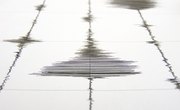
Hertz, the unit of frequency as defined by the International System of Units, or "SI," represents the number of times per second a signal oscillates. If a given wave is moving, such as light, the path can be thought of as a point traversing a sine wave. The absolute difference between the high peaks and low peaks is the amplitude; the distance between the peaks is the wavelength. As frequency changes so does the wavelength. All that is required to make the conversion between frequency and wavelength is the speed of the propagating signal. The speed of light in a vacuum is a universal constant and is defined as exactly 299,792,458 meters (186,282.397 miles) per second.
- Pen
- Paper
- Calculator
A higher frequency results in a shorter wavelength. The wavelengths of the electromagnetic spectrum span lengths between less than 10 picometers, gamma ray, to thousands of miles for ultra low frequency.
Frequency is almost always measured in Hertz. If the frequency is measured in MHz, for example, simply multiply the number by the multiplying factor. For example, 2.5 MHz = 2,500,000 Hz.
Measure, or otherwise obtain, the frequency and velocity of propagation of the signal in question. If the signal is produced by an electronic device, the frequency will either be marked or detailed in the manufacturer's data sheet. If the frequency cannot be determined, a spectrum analyzer or laboratory testing will be required. Calculating the velocity may require high speed detectors. If the wave is electromagnetic, use the speed of light (c).
Divide the velocity of propagation by the signal's frequency. If the units of measurement for the velocity are in meters then the wavelength will be in meters.
Convert the wavelength, measured in meters, to nanometers, by dividing this number by 1,000,000,000, 10 to the 9th power. The quotient is the wavelength of the given frequency (Hz) measured in nanometers (nm).
Things You'll Need
Tips
References
About the Author
Jesse Randall studied mathematics and physics and works as an embedded electronics engineer, developing microcontroller firmware and digital interfaces. He writes about subjects including abiogenesis, electrochemistry and algorithm optimization. He has been writing on technology-related subjects since 2000.