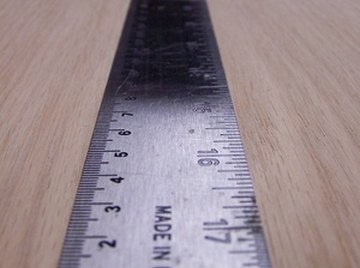

In the second half of the 17th century, French intellectuals devised a metric system now used throughout the world. The French Academy of Science was motivated to create such a system due to commercial, exploration/imperial and scientific requirements of the time. The metric system is defined in terms of almost unchangeable physical quantities and can be used from the subatomic to astronomical realms without need for excessive name or conversion factor memorization.
Trade
Before the metric system was used, different localities and villages within France used their own separate measurement systems. The potential for error increased every time business product variables (such as weight, composition and transport speed) had to be converted from one arcane unit to another. Aside from the obvious inefficiency and lack of precision, such a practice could easily lead to corruption. A locality could tweak its stated measurements depending on how favorably it saw a trading party. The metric system did away with such inefficiencies and opportunities for subtle but, especially over time, substantial swindling.
Exploration and Empire
As with business and science, confusing and obscure units muddle communication of ideas and facts. The metric system helped French explorers to determine and convey where they were in relation to set points in the world. In the case of exploration (as with science/technology, to some extent), not just units but “easy” multiples of units were required. The metric system solved this problem by adding a set of prefixes that denote some power of 10 acting on a basic unit. Hence, a kilometer is 1,000 meters, with a kilometer a convenient unit of distance in navigation. Similarly, a nanometer--used in chemistry and physics more than in travel--is one-millionth (10^-6) of a meter.
Science
Virtually no hope of communicating discoveries or conveying invention schematics exists without established standards of weight, distance, electric charge and magnetic force, for example. While different units can be convertible, as with the English and metric systems today, the idea of measurements based on (ideally) unchanged physical quantities is as prevalent today as it was when the metric system was conceived.
Precise Physical References
Precisely engineered metallic bars were the physical definition and “embodiment” of a meter and a kilogram, and science advanced standards used to define metric units. Whereas at first a meter was the length of a certain rod kept in isolation from the environment—to prevent corrosion and contamination—now a meter is defined as the distance light travels in a defined fraction of a second; the second itself is defined in terms of other atomic/electromagnetic phenomena.
Nomenclature and Simplicity
The English system’s path from inch to mile is as follows: Twelve inches are in 1 foot, 3 feet in 1 yard, 22 yards in 1 chain and 80 chains in 1 mile. By contrast, prefixes “milli-,“ “centi-,“ and “deci-“ denote 1/1000th, 1/100th and 1/10th of a meter (or any other base unit such as a gram and coulomb) with clarity. Ten-based “stepping stones” clearly denoted in the very name of a measuring unit (such as centimeter, kilogram and megahertz) create a key metric system advantage.
References
About the Author
I am applying to be an Expert focusing on sci/tech/economic topics. The above "blog" link was my overall blog. From it, I would like to highlight some choice entries reviewing Ian Stewart's "Flatterland", a response and "supplement" to Edwin Abbott's classic "Flatland -- A Romance Of Many Dimensions" 1. http://numbersandpatterns.wordpress.com/2009/07/09/flatterland-review-1/ 2. http://numbersandpatterns.wordpress.com/2009/07/18/flatterland-review-2/ 3. http://numbersandpatterns.wordpress.com/2009/07/24/flatterland-review-2-5-fractal-afterthought/ 4. http://numbersandpatterns.wordpress.com/2009/08/03/flatterland-review-3/
Photo Credits
steel ruler image by dwags from Fotolia.com