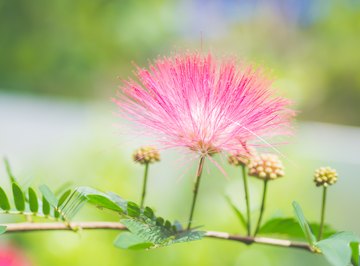
The beautiful mimosa tree, also known as the silk tree, grows easily in warm climates. Its adaptability allows it to spread to into a variety of habitats, and its prolific reproduction allows it to spread quickly. Once the blooms fade, the resulting seed pods contain substances that can be toxic to animals.
TL;DR (Too Long; Didn't Read)
The seeds and seed pods of the mimosa tree are toxic to animals that eat the pods. The alkaloids within the seeds and pods can cause symptoms like convulsions and breathing difficulties.
Beauty Is Skin Deep
The mimosa tree (Albizia julibrissin) was first cultivated as an ornamental following its introduction to North America from Asia in 1745. Its delicate, feathery pink flowers, frond-shaped leaves and graceful, umbrella-shaped silhouette make it an attractive specimen in the garden. The tree easily adapted to the mild climate of the southern colonies and escaped the confines of cultivation. As a naturalized species, it spread throughout the South and West. Today the mimosa tree is considered a nuisance due to its invasive nature. It also presents a danger to animals because of its toxic seed pods.
Pioneer Species
The mimosa tree is a pioneer species and establishes itself in disturbed areas, such as vacant lots and abandoned fields and can adapt to a variety of soils. The tree succeeds in both open areas and forest edges, as well as along road sides. It is classified as a legume and produces seed pods to propagate. Its ability to produce a copious amount of tough, leathery seed pods not only creates a mess in the garden but also allows the tree to spread quickly into a variety of environments. Trees growing near rivers and streams take advantage of the free transportation to spread their seeds by water.
Toxic Seed Pods
Because mimosa trees can pop up quickly and spread easily, they are a common species in pastures and on the range where livestock graze. While they provide welcoming shade and leaves for browsing, the poisonous seeds can cause health problems when grazing animals such as cattle, sheep and goats eat them. The mimosa tree’s prolific seed production creates a windfall for hungry livestock. Toxicity can be measured in mass of seeds consumed proportionate to body mass. Symptoms appear when animals consume 1 to 1.5 percent of their body weight in seeds. Unfortunately, the toxicity associated with consuming excessive amounts of the seed pods can be fatal.
Alkaloids and Vitamin B6
The seeds of mimosa trees contain chemicals called alkaloids. The alkaloids present in these seeds counteract the actions of vitamin B6 in the body. Vitamin B6 is essential for producing neurotransmitters, which send signals between nerve cells. Consuming mimosa seed pods can result in muscle tremors, muscle spasms and convulsions due to the antagonistic effect that the alkaloids have on vitamin B6. Affected animals may present with locomotion problems and display abnormal movements when turning or backing up. Exaggerated responses to stimuli, salivation and difficulty breathing have also been observed. Symptoms typically manifest 12 to 24 hours after eating the seeds. Animals poisoned by mimosa seeds are treated with injections of vitamin B6. However, animals that browsed on a large quantity of seed pods may experience a recurrence of symptoms.
References
About the Author
A.P. Mentzer graduated from Rutgers University with degrees in Anthropology and Biological Sciences. She worked as a researcher and analyst in the biotech industry and a science editor for an educational publishing company prior to her career as a freelance writer and editor. Alissa enjoys writing about life science and medical topics, as well as science activities for children