Neustockimages/E+/GettyImages
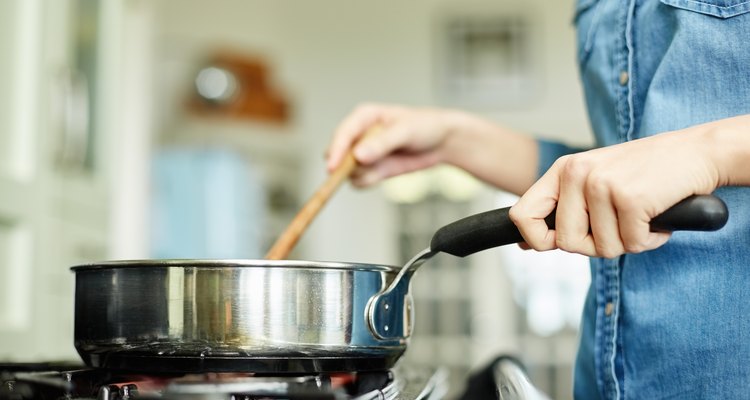
When choosing cookware for yourself and your family, the primary criteria is always health and safety. In recent years, a number of chemicals used in certain cookware and kitchen appliances have been known to contain carcinogens and even greenhouse gases when they are heated to a high temperature. Titanium cookware is generally safe, but if you are shopping for titanium pans, there are certain things for which you will want to look out.
What Is Titanium?
Titanium is one of the strongest metals found on earth. It is lightweight and has the highest strength-to-weight ratio of any metal on earth. It has the same strength as stainless steel while being only half the weight. It is durable, does not oxidize and resists corrosion. It will form a protective layer of film on its exterior to prevent corrosion and can self-heal from scratches easily.
Titanium has many uses, from hardware and plumbing to jewelry and cookware. It is popular because of its durability, and it is lightweight, which makes it a natural fit for household items. Despite the fact that titanium is a fairly poor conductor of heat, it has become increasingly popular as a cookware material. Titanium cookware is easily found in a number of stores and is prized for its strength and for being so lightweight.
How Is Titanium Cookware Constructed?
There are typically two varieties of titanium cookware. One kind is pure titanium. This means that the core of the cookware is titanium, and it may be pure titanium throughout or it may be coated with ceramic and silicone. The other kind of titanium cookware is typically called "titanium reinforced" and is generally fashioned of an aluminum base with a cooking surface that has been infused with titanium.
While pure titanium cookware isn't great for everyday cooking because of the uneven distribution of heat and the way that food sticks to the pan, it is good for traveling because of how lightweight it is. It also resists corrosion, which makes it ideal for unpredictable climates, and it is strong enough to not bend.
On the other hand, titanium cookware that has been infused with titanium typically has an aluminum base which has far superior heat conducting and retention properties. The base is then coated with titanium-infused ceramic coating with nonstick properties to make cooking and cleaning easier. This way, it maximizes the strength of titanium while still offering the kind of heat distribution that is necessary to cook well.
Is Titanium Cookware Safe to Use?
There have been many discussions in recent years about the health and safety of various cookware. Of particular concern has been nonstick cookware. The worry around nonstick cookware is that the chemicals from the nonstick coating can leach into the food that is cooked and then consumed. Apparently, tests have shown that many of the chemicals in nonstick cooking surfaces are dangerous, and some have even been tested and found to be carcinogenic.
Pure titanium cookware without a nonstick coating is safe to use and is perhaps among the safest varieties of cookware. Unfortunately, it's not great for actual cooking. The poor heat retention and distribution properties make it very difficult to use with any degree of precision, and the cooking surface causes food to stick to it, making it difficult to clean and often causing the food sticking to the surface to burn. For this reason, people tend to want a nonstick cooking surface.
However, not every nonstick coating is dangerous. Aluminum cookware with a titanium-infused ceramic coating, for example, is safe and nonreactive to humans. It contains no chemicals that have shown to have adverse reactions in human beings. In fact, some of the materials used in this coating are actually used in medical implants that are designed to be placed into the human body.
How Do I Choose Which Cookware Is Safest?
Ultimately, choosing the kind of cookware you buy comes down to the needs of you and your family. If you feel that titanium pans without the coating are the safest and the most convenient for your lifestyle, it may be worth it to put up with the hassle of poor heating and sticky cooking surfaces.
However, if you cook regularly and often, and if the integrity of your cooking relies on the quality of heat you are able to distribute on the surface of your pan, you may find that the pure titanium cookware isn't good enough for what you need. In this case, you will need to find a kind of cookware that has a nonstick surface but that is absent of chemicals that are known to cause problems.
Titanium cookware could potentially be the right choice for you particularly if you are comfortable with the titanium-infused ceramic coating. It has been documented that titanium ceramic coating is safe for cooking and does an excellent job of retaining heat and distributing it evenly across the surface of the pan.
What Is the Best Metal to Cook Food?
Aluminum cookware, copper cookware and cookware coated with Teflon have been known to cause problems, to leach chemicals into food and to expose people to dangerous chemicals when heated. However, there are a number of new, modern coatings that do not have any of the problematic chemicals of older cookware and are absolutely safe regardless of the metal.
While exposure to a small amount of aluminum is not deadly or dangerous, it is true that there is an amount that is toxic or dangerous to humans, but scientists have not yet agreed upon what that toxicity level is. In the meantime, the best strategy is to avoid aluminum altogether, as there are much better options with less of a safety risk.
Cast iron cookware is one of the best options out there. Not only does it distribute heat evenly and cleanly, it is a very safe metal with which to cook. Although cast iron skillets are sticky to begin with, the seasoning you are meant to do with oil to keep the skillet clean can help to create a perfect nonstick surface over time.
What Other Metals Are Safe for Cooking?
Beyond cast iron, there is a range of porcelain enamel cookware that has tested quite well for safety. Brands like Le Creuset have a porcelain coating, but not all enamel cookware is created equal. Certain brands have tested very high for lead, although Le Creuset has shown no troubling results for either lead or cadmium.
Xtrema cookware is a safe ceramic cookware company that has some of the cleanest results and leaches nothing into the food that's cooking on its surface. The challenge with ceramic cookware is that it is easily breakable. It can be difficult to learn how to cook on ceramic surfaces, but it is something that can be learned. As an added bonus, the ceramic has a no-scratch surface, making it easy to clean. It also holds flavor and distributes heat evenly.
Stoneware is another option for cooks hoping to avoid the worries surrounding cookware. Stoneware is best for baking rather than stovetop cooking, but it's still one of the absolute safest alternatives to aluminum cookware. It can be challenging to clean, as stone can quickly absorb the flavor of soap. However, stoneware cooks very evenly even if it is heavy, and it is often sold in attractive colors.
Related Articles

What "Tools of the Trade" Cookware is ...
Are Nickel Lined Pans Safe?

Is Cooking With Galvanized Aluminum ...

Why Does Food Stick to a Non Stick Pan?

What Kind of Cans Are Used for Canned ...

What Are the Benefits of Stoneware ...

Dutch Oven Vs. Cooking Pot
How to Cook With Stainless-Steel Frying ...

What is a Paella Pan?
Anodized Vs. Teflon in Cookware
What Is Magnalite?
What Is the Best Cookware for Electric ...
What Are the Dangers of Cooking With ...
The Advantages of Wok Cooking
Is Revere Ware Aluminum?
Healthy Non-Stick Cookware

Can You Use a Glass Pan to Cook a Roast?

What Kind of Pan Can I Use to Cook a ...

Alternatives to a Deep Fryer

Characteristics of Oven-proof Plates
References
Writer Bio
Ashley Friedman is a freelance writer with experience writing in the culture and lifestyle space for established brands and digital media