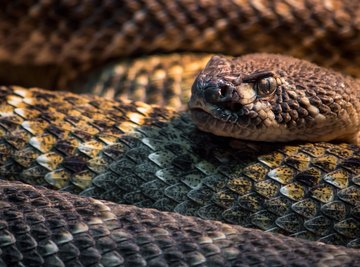
Pit vipers are a subfamily of venomous vipers found in the Americas and Asia. They take their name from the pair of heat-sensing "pits" located between each eye and nostril. They possess a sophisticated venom delivery system with hinged tubular fangs that can be folded away when not in use, according to the University of Pittsburgh. They are the only kind of viper found in North America. Groups in the subfamily include rattlesnakes, bushmasters and lanceheads.
Mating
Like all snakes, pit vipers mate by internal fertilization. The male penetrates the female's cloaca, or posterior opening, with one of a pair of organs called hemipenes, which are stored in his tail. All pit vipers have mating seasons, but the timings of these vary depending on the species. Some species have mating rituals. Competing male eyelash palm pit vipers go through a ritual known as "the dance of the adders," according to the Smithsonian National Zoological Park. The males face each other with the head and forebody held erect and try to push each other to the ground in a contest that can last for hours.
Live Births
Most pit vipers are ovoviviparous. This means the females produce eggs that hatch inside their bodies. The young develop within the mother for some time, feeding on the egg yolks rather than through a placental connection. They will then be birthed live, in a brood that can range from two to 86, depending on the species.
Eggs
The bushmaster is the only oviparous, or egg-laying, species of pit viper in the Americas, according to Seattle's Woodland Park Zoo. When the female is ready to lay her eggs, she will take possession of another small animal's burrow and lay eight to 12 eggs. Each is slightly larger than a chicken's egg and takes between 76 to 79 days to hatch. The female will stay in the burrow to guard the eggs until they hatch.
Young
Most young pit vipers are able to hunt and deliver a venomous bite. Some have a different coloration than the adults. Young bushmasters have bright orange or yellow tail tips that may help lure insectivorous mammals into striking range, according to Seattle's Woodland Park Zoo. Young rattlesnakes can be more aggressive than adults, according to the Desert USA website. They will stay in the area of their birth for the first seven to 10 days but are completely independent of the mother.
Lifespan
It is difficult to calculate the average lifespan of a pit viper in the wild but it is likely to be shorter than that of one in captivity due to factors such as disease, predation and hunger. Eyelash palm pit vipers can live more than 16 years in captivity, according to the Smithsonian National Zoological Park. Bushmasters typically live between 12 to 18 years in captivity, with a maximum recorded lifespan of 24 years, according to Seattle's Woodland Park Zoo. The average lifespan of a rattlesnake in captivity is between 20 to 30 years.
References
About the Author
Paul Travers has worked as a freelance journalist since 1990. He has worked primarily for "Kerrang!," the U.K.'s leading rock magazine, but he has also published online content and in print publications worldwide, from "MusikExpress" in Germany to "Smash Hits" in Australia. Travers holds a Bachelor of Arts in journalism and media studies from the University of Central Lancashire.