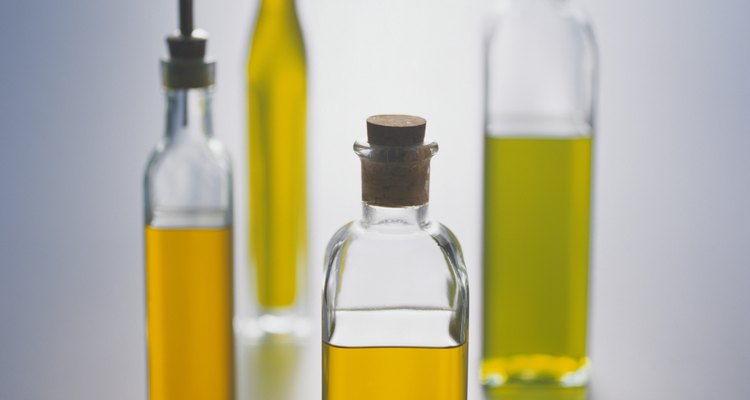
You have numerous choices when cooking with oil, but the oils you use shouldn't contribute any flavor or smell of their own. Cooking oils that are free of taste and smell are referred to as "neutral"; they undergo a refining process that homogenizes their appearance, extends their shelf life and increases their smoking point, or the temperature at which they start to smoke. Only five oils fit the criteria for odorless cooking oil: corn, peanut, safflower, sunflower and canola.
Canola Oil
Readily available, inexpensive and a high smoke point make canola oil the first choice for cooking. Unless labeled otherwise, canola oil undergoes a chemical refining process to increase its stability, smoke point and remove any color and smell. The archetypical neutral oil, the term "canola" is a portmanteau of the words, "Canadian oil low acid," but it's actually derived from a plant related to rapeseed. Canola oil has a smoke point of 435 degrees Fahrenheit, making it suitable for baking and deep-frying, which occurs around 350 F, and sauteing, which uses temperatures between 350 and 400 F.
Safflower and Sunflower Oil
Safflower oil comes from the seeds of the safflower plant and sunflower from sunflower seeds. Like canola oil, sunflower and safflower oil are refined for a homogenous appearance, taste and smell, unless it's labeled "unrefined." Safflower oil starts smoking between 450 and 510 F, making it useful for flash frying, an Asian cooking technique in which food is cooked in a wok filled with about 1 or 2 inches of 425- to 450-F oil. Safflower does well in cold preparations too, and it's a common ingredient in mayonnaise, vinaigrettes and other cold sauces and dressings. Use high-oleic-acid safflower and sunflower oil for cooking.
Peanut Oil
Peanut oil comes in four varieties: refined, unrefined, roasted and cold pressed, and each type possesses various strengths in terms of smell and smoke point. Refined peanut oil, the variety with the lowest smell and the type best suited for cooking, has a smoking point of 450 F, making it a staple in Asian kitchens and the pantries of cooks who deep-fry frequently. The refining process peanut oil undergoes removes the proteins that act as allergens in peanut-sensitive people, so they can consume it without the threat of a reaction.
Corn Oil
Refined corn oil has little to no smell or taste, and it starts smoking at 450 F. Corn oil tolerates all forms of cooking and works well in baked goods in which you need transparent color and neutral taste. Corn oil is one of the least expensive vegetable oils and one of the most common oils on the market.
Keeping Your Cooking Oil Odor Free
All types of oil are expensive if you waste it. You can reuse neutral, odorless oils after deep-frying for up to one month if you don't heat them past their smoking point, strain them of debris and store them in an airtight container. After deep-frying, let the oil cool until it's warm. Line a sieve or strainer with a couple of layers of cheesecloth and set it over a storage container. Pour the oil through the sieve into the container and seal it. Mark the date on the container and store it in the refrigerator. You can reuse oil until it starts to take on a smell or gets too dark for your taste.
Related Articles
How Long Can You Keep and Reuse Peanut ...

Cold Pressed vs. Expeller Pressed
What Kind of Oil Should I Use to ...
Does Cooking Oil Go Bad?
Can Doughnuts Be Deep Fried in Olive ...
Substitutes for Groundnut Oil in Cooking
Sesame & Peanut Oil for Cooking
What Is Expeller Pressed Canola Oil?
What is Rapeseed Oil?
What Type of Oil Can I Use to Deep Fry ...
Is It Safe to Reuse Your Cooking Oil to ...
Can You Reuse Fish Frying Oil for Other ...
The Shelf Life of Pumpkin Seed Oil

Cooking With Camellia Oil

How to Deep-Fry Frozen Potstickers
Oils Good for Cooking at High ...
What Are the Benefits of Krill Oil on ...

How to Make Homemade Tortilla Chips
Do You Need to Refrigerate Infused ...

Almond Oil Cooking Substitution
References
Writer Bio
A.J. Andrews' work has appeared in Food and Wine, Fricote and "BBC Good Food." He lives in Europe where he bakes with wild yeast, milks goats for cheese and prepares for the Court of Master Sommeliers level II exam. Andrews received formal training at Le Cordon Bleu.
Photo Credits
Duncan Smith/Photodisc/Getty Images