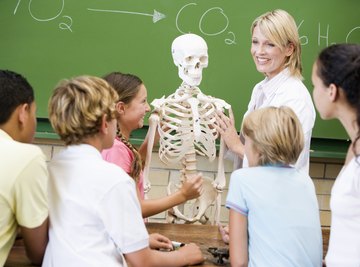

The skeletal system is divided into two parts: the axial skeleton and appendicular skeleton. The axial skeleton includes the skull, spinal column, ribs and sternum. The appendicular skeleton includes all upper and lower extremities, the shoulder girdle and the pelvic girdle. Bones in the human body come in four main shapes, long, short, flat and irregular and are composed of webs of collagen fibers reinforced with calcium and phosphorous.
The collagen provides flexibility while the minerals provide tensile strength. There are 5 functions of the skeletal system in the body, three of which are external and visible to the naked eye, and two of which are internal. The external functions are: structure, movement and protection. The internal functions are: blood cell production and storage.
1. Structure
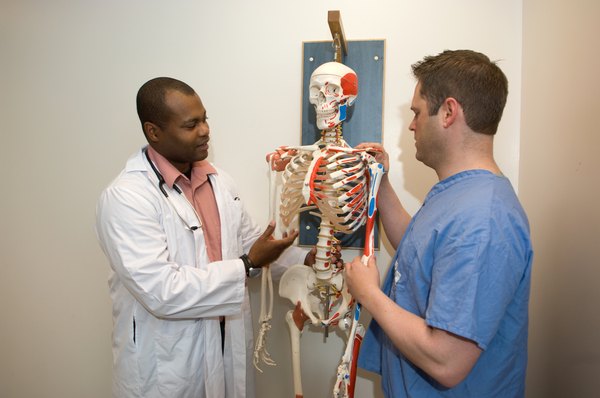
Like the steel framework of a building, the functions of the skeleton and the bones is to provide rigidity, which gives the body shape and supports the weight of the muscles and organs. Without this structure, the body would collapse in on itself, compressing the lungs, heart and other organs--impairing their function.
Some creatures do not have internal skeletons and instead they have external shells (or exoskeletons) with muscle attachments on the interior. The rigid structure of the skeletal system also allows it to perform another one of the 5 functions of the skeletal system: movement.
2. Movement
There are three major systems involved in the mechanics of movement:
- Nervous system
- Muscular system
- Skeletal system
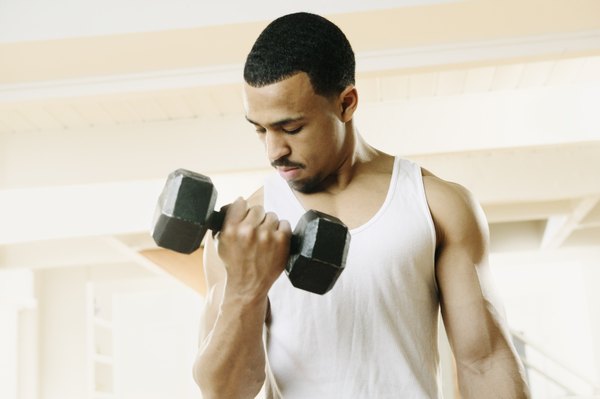
The nervous system sends the electrical impulses that activate the muscles, the skeletal system provides the levers and anchors for the muscles to pull against. All skeletal muscles have an origin and insertion point.
The origin is the anchor, the bone that remains immobile while the muscle works. The insertion is the bone that moves as the muscle works, which is one of the main functions of the skeleton. So, for example, in the case of the biceps, the upper arm and shoulder are the origins (anchor) and the bones of the forearm are the insertion. Interestingly, the amount of power the muscle needs is directly related to the length of the bone (or lever) and where it is attached.
This means that shorter people actually use less power to move than taller people because they have shorter bones, and the point of attachment is closer to the point of origin.
3. Protection

Arguably the most important of the 5 functions of the skeletal system is protection. The most obvious example of the functions of the skeleton's protective properties is the human skull. The vertebrae and ribs also have protective functions by encasing delicate structures like the spinal cord, heart and lungs. The rib cage not only surrounds the organs of respiration, but it’s also very flexible and is constructed to expand and contract with each breath.
The bones of the skull are actually several flat plates joined together by sutures. These sutures allow the skull to pass through the birth canal and expand as the brain continues growing. The sutures fuse together in early childhood, forming the classic shape of the skull.
The vertebrae are all irregularly shaped bones in the human body that provide both protection and flexibility for movement. There are also fibrous disks between each vertebra, which provide shock absorption.
4. Blood Cell Production

Red and white blood cells are made in the red marrow of bones. At birth and in early childhood, all bone marrow is red. As the person ages, about half of the body’s marrow turns to yellow marrow – which is composed of fat cells. In an adult human, a majority of the long bones contain yellow marrow, and the red marrow is only found in the flat bones of the hip, skull and shoulder blades, the vertebrae and at the ends of the long bones.
However, in the event of severe blood loss, the body can convert some yellow marrow back to red marrow to increase blood cell production.
5. Storage

The body uses calcium and phosphorous for bodily processes like muscle contraction. Some of those minerals are found in our diet, but they are also taken from the bones in the human body. When the body needs calcium, if there isn’t a ready supply in the blood, the endocrine system releases hormones that initiate the process of taking calcium from bone and releasing it into the bloodstream. When there is a surplus of blood calcium, it’s put back into the bones.
This is why dietary calcium and vitamin D are so important. The body uses calcium constantly and, if there isn’t enough calcium in the diet, it will consistently take calcium from the bone to compensate – leading to osteoporosis. Having enough dietary calcium ensures that there is enough calcium for bodily functions and replenishes the backup stores in the bone.
References
About the Author
Julia Michelle has been writing professionally since January 2009. Her specialties include massage therapy, computer tech support, land and aquatic personal training, aquatic group fitness and Reiki. She has an Associate in Applied Science from Cincinnati State Technical and Community College in integrative medical massage therapy.
Photo Credits
BananaStock/BananaStock/Getty Images