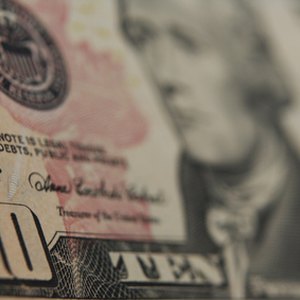


The first paper money issued by the U.S. Treasury Department debuted in 1861, as a means of financing the Civil War. Congress soon replaced these original demand notes, or "greenbacks," with "legal tender notes." Since that time, United States currency has changed drastically. Because technological advances have made counterfeiting possible for anyone with basic computer equipment and skills, the federal government has equipped paper currency with a special security thread that runs through the paper and identifies the denomination of the bill. Counterfeiters cannot easily replicate this security thread. Modern bills also include microprinted words that standard photocopiers cannot duplicate.
Examine the portrait in the center of a paper bill. The portraits on genuine bills are of high quality, and stand out sharply from the background of the bill. The portraits on counterfeit bills often seem flat, and are harder to distinguish from the background.
Locate the green treasury seal on a paper bill and examine it closely. The treasury seal on a genuine bill is edged with evenly spaced sawtooth points that look sharp and clear. Counterfeit bills often sport treasury seals with imperfect or uneven sawtooth points.
Check the serial numbers on paper bills. Serial numbers on genuine bills have perfectly even spacing, and the ink is exactly the same color as the treasury seal. The serial numbers on counterfeit bills are more likely to have a different ink color and irregular spacing.
Look at the border around the edge of the paper bill. Genuine bills have a clear, sharp, distinct border. Counterfeit bills often have a blurry or wavy border.
Note the face value of the paper bill, and make sure the denomination numbers at its top corners match the denomination printed across the bottom. Counterfeiters sometimes try to add value to a bill by changing the top numbers.
Examine the paper carefully. The paper of genuine bills is embedded with very small red and blue fibers. Counterfeiters may try to imitate the appearance of these fibers by printing red and blue lines directly onto the paper.
Hold the bill up to a light source and look for a vertical security thread that runs from the top edge to the bottom edge. You will find this thread next to the Federal Reserve Seal. The thread repeatedly identifies the denomination of the bill along its length.
Examine United States coins to make sure they are genuine. The United States government stamps genuine coins using a machine. By contrast, counterfeiters usually make coins with a mold, which can result in unusual marks or cracks in these coins. Counterfeiters may also change the dates and mint marks of collectible coins in an attempt to increase their apparent value.
Tips
A counterfeit bill detector pen can help you identify fake money. Write a small line on a paper bill with the pen. If the bill is genuine, the line will turn yellow. If the bill is counterfeit, the line will turn brown or black.
If you find fake money in your possession, handle it as little as possible. Place it into an envelope, and call the police or the U.S. Secret Service.
References
Tips
- A counterfeit bill detector pen can help you identify fake money. Write a small line on a paper bill with the pen. If the bill is genuine, the line will turn yellow. If the bill is counterfeit, the line will turn brown or black.
- If you find fake money in your possession, handle it as little as possible. Place it into an envelope, and call the police or the U.S. Secret Service.
Writer Bio
Kathryn Hatter is a veteran home-school educator, as well as an accomplished gardener, quilter, crocheter, cook, decorator and digital graphics creator. As a regular contributor to Natural News, many of Hatter's Internet publications focus on natural health and parenting. Hatter has also had publication on home improvement websites such as Redbeacon.