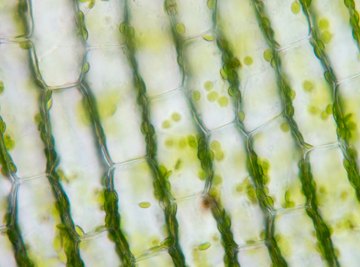
Cell division consists of steps that lead to the creation of another cell. When plants and animals reproduce their cells asexually, the process is known as mitosis. Cell division varies between animals and plants, but there are many steps in common. The differences have largely to do with specialized structures in each type of cell. Plants have both a cell membrane and a cell wall, whereas animal cells have no cell wall. Animals also have cell centrioles, but higher plants don't.
Steps in Cell Division
The steps in cell division are very similar between plant and animal cells, but the formation of the spindle and cytokinesis are different in plants. The mitosis process undergoes five steps: prophase, prometaphase, metaphase, anaphase and telophase. These steps are defined by chromosomes condensing, temporary removal of the nuclear membrane, separation and movement of separated chromosomes to opposite ends of the cell by spindle fibers. Once the chromosomes have separated, new nuclear membranes form and the cell divides in half -- an event called cytokinesis.
Formation of the Spindle in Animal Cells
Animal cells contain two clusters of microtubules and centrioles, collectively termed centrosomes, located at poles of the cell. During prophase, the microtubules within the centrosome begin lengthening toward the chromosomes in the nucleus. The microtubules are referred to as spindles at this point. Spindles orchestrate the careful organization and segregation of chromosomes between daughter cells during mitosis. Some of the microtubules extending from the centrosome also participate in cytokinesis after the last stage of mitosis.
Formation of the Spindle in Plant Cells
Most plants do not contain centrioles, but instead have microtubule clusters that function to direct the distribution of chromosomes. They also participate in splitting the cell during cytokinesis. During prophase, the plant cell begins to produce spindles from the organizing centers that grow into the nuclear region and attach to the chromosomes. From there, they orchestrate the organization and segregation of chromosomes between daughter cells during mitosis.
Differences in Cytokinesis
In animals, the cell is split from the outside by a contractile ring, forming a cleavage furrow. A layer of actin and myosin filaments underneath the plasma membrane at the cell center begins to contract until the cell is essentially pinched in half. In plants, a new cell wall forms inside the cell that grows outward until the formation of two new cells. The assembly of a new cell wall forms by vesicles filled with cellulose and lignin, which eventually fuse together to create a new cell wall, and the parent cell splits in two.
References
About the Author
Stacy Taylor is an accomplished scientist, educator and writer. Taylor has a bachelor’s degree in human biology, a master’s degree in microbiology and additional graduate work in biomedicine and public health. Taylor has been teaching college biology courses since 1998.