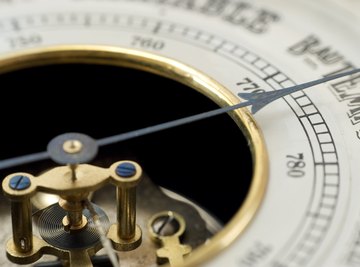
Barometric pressure, an indicator of the weight of column of air, ranges from an historic high of 32.01 inches to an all-time low of 25.9 inches. Electronic barometers now are available in addition to older-style units that use a needle and dial to track pressure changes. Changes in barometric pressure correspond to changes in weather and pressure extremes are often associated with extreme weather events.
Amount of Barometric Change
Barometric pressure often is measured in inches of mercury, or in-Hg. If barometric pressure rises or falls more than 0.18 in-Hg in less than three hours, barometric pressure is said to be changing rapidly. A change of 0.003 to 0.04 in-Hg in less than three hours indicates a slow change in barometric pressure. A change of less than 0.003 in-Hg in less than three hours is considered to be holding steady.
Time and Pressure Change
Approaching storms and wind cause barometric pressure to decrease. Rising pressure indicates fair weather. The longer it takes barometric pressure to change, the longer the coming weather pattern can be expected to last. It is possible that a small weather event, such as a passing shower, may trigger no change in barometric pressure.
Record Barometer Readings
The highest barometric pressure ever recorded was 32.01 inches. This reading was taken in Agata, Siberia, on December 31, 1968, during clear and extremely cold weather. The lowest known barometric pressure was recorded over the Pacific Ocean during a typhoon on October 12, 1979. The pressure was 25.9 inches.
References
About the Author
Writing professionally since 2008, Michelle Miley specializes in home and garden topics but frequently pens career, style and marketing pieces. Her essays have been used on college entrance exams and she has more than 4,000 publishing credits. She holds an Associate of Applied Science in accounting, having graduated summa cum laude.