
Life Cycle of a Squid

Life Cycle of a Squid thumbnail
Marine biologists predict that global warming will produce a squid bloom.

Squids belong to a group of mollusks called cephalopods of the order Teuthida, which includes about 800 species. Cephalopods appeared on Earth several million years before primitive fish, and despite their short life spans, they have a thriving population.

  1. Squids Have Arms and Tentacles

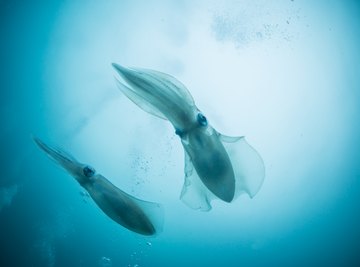
    • Like all cephalopods, a squid's body features a distinct head, and the right side of its body mirrors the left half, a feature scientists call bilateral symmetry. All squids have a mantle or a soft exterior membrane that encloses the gills, and arms and tentacles. Squids have short life spans and teuthologists--the marine biologists who study them--are still learning about their life cycles, focusing especially on the giant Humboldt and colossal squids.

    Weeds of the Seas

    • Squids usually live from three to five years. Scientists call this quick life history "r-selection," with the r signifying extreme reproduction and growth. In life history terms, cephalopods are the weeds of the seas and they have the potential to out-reproduce fish and mammal populations. Despite overfishing and climate change, there may be more squids now than any time in history.

    11 Pounds of Eggs

    • Male squids store packets of sperm called spermatophores in specialized long arms, which penetrate the female's mantel during a mating session that lasts just 15 seconds. Squids usually spawn in groups and females release up to 11 pounds of eggs. Most squids lay their eggs in masses on the sea floor, but some carry a clutch of eggs in their arms to guard them. Adult squids don't live long after mating.

    Baby Stages

    • Baby squids hatch as larvae and grow into maturity in about three to five years. Marine biologists believe that short finned squids don't live any longer than 12-18 months. Spawning females release about 100,000 eggs, and most hatch in about two weeks. The hatchlings progress first to the larval, next to the juvenile and then to the squid stage.

    Water Quality

    • Squid species are common all over the world in such numbers that there is a thriving squid fishing industry. Squid numbers are a good indicator of water quality, because squids leave polluted water to congregate in cleaner water. Their abundant numbers are also important to the balance of the ecosystem, since predators like sperm whales, sea birds and seals depend on them for food.

    Population Explosion

    • Squid populations seem to be increasing with global warming, and marine research suggests that the total body mass of squids on Earth far exceeds the mass of humans. Some marine biologists predict that rising global temperatures will speed up metabolism and growth in cephalopods, producing a squid population explosion.

Related Searches:

References

Resources

  • Photo Credit Image by Flickr.com, courtesy of Chris Walters

Comments

You May Also Like

  • Mollusk Life Cycle

    Mollusks make up a scientific phylum of soft-bodied creatures, most often enclosed in a shell. The mollusk's body contains the digestive and...

  • Life Cycle of a Vampire Squid

    A creature of the deep sea, vampire squids (Vampyroteuthis infernalis) spend their entire live cycle in tropical and temperate parts of the...

  • Giant Squid Science Projects

    The giant squid is a fascinating and mysterious ocean creature. It has been seen in its natural habitat only a few times...

  • Life Cycle of Giant Panda Bears

    Scientists once believed that the giant panda bear was a species of raccoon, but genetic testing in 1995 confirmed that pandas are...

  • Life Cycle of Fur Seals

    There are currently nine known species of fur seals, all of which are more closely related to sea lions than actual seals....

  • Life Cycle of a Swordfish

    The swordfish, recognized by its distinctive sword-like bill, is a predatory fish found in seas worldwide. A swordfish can live up to...

  • Plaster Squid Science Projects

    Science projects commonly use unique displays to help demonstrate what the student has learned. Students can use plaster squids as a display...

  • Diet of a Squid

    A hungry squid is a ruthless and highly efficient carnivore. Its muscular arms are covered along their length by suckers which help...

  • Invertebrate Life Cycle

    Invertebrates are animals without backbones, and they are the largest group of animals. This group includes insects, arachnids, worms, mollusks, crustaceans ...

  • The Complete Life Cycle of the Giant Panda

    The giant panda is a relative of the bear and is native to mountain ranges of central China. This creature once had...

  • Macaroni Penguins Life Cycle

    There are more macaroni penguins than any other type, with the International Penguins Conservation Work Group estimating there are nine million breeding...

  • Body Parts of a Squid

    Squid are cephalopods, which are the largest and most active invertebrates. The most common type of squid is the Humboldt or jumbo...

  • The Life Cycle of a Hammerhead Shark

    There are nine species of hammerhead sharks. They are found in oceans all over the world. The hammerhead is easily identified by...

  • Specialized Body Parts of Giant Squids

    Thought by some to be a myth, the giant squid has eluded marine biologists for years. Long before it could be classified...

  • Red Devil Squid Facts for Kids

    The Humboldt Squid, scientific name Docidicus gigas, is also known as the Red Devil Squid, the Jumbo Flying Squid and the Jumbo...

  • Elementary School Projects With Squid

    Squid are invertebrates, belonging to the group of mollusks called cephalopods. This group also includes octopus and cuttlefish. They are an easy...

  • What Are the Suction Cups Used for on the Tentacles of a Squid?

    Squid are close relatives of octopus. Both are highly intelligent mollusks and predatory carnivores. Most squid species have 8 arms and two...

  • Life Cycle of an Average Star

    Starfish belong to a group of animals known as Astroidea, meaning having rays or arms. Although sea stars are simple organisms as...

Related Ads

Featured