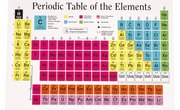
The periodic table lists all the known elements by increasing atomic number, which is simply the number of protons in the nucleus. If that were the only consideration, the chart would be simply a line, but that is not the case. A cloud of electrons surrounds the nucleus of each element, typically one for each proton. Elements combine with other elements and with themselves to fill their outer electron shells according to the octet rule, which specifies that a full outer shell is one that has eight electrons. Although the octet rule does not apply as strictly to heavier elements as lighter ones, it still provides the basis for the organization of the periodic table.
TL;DR (Too Long; Didn't Read)
The periodic table lists the elements by increasing atomic number. The shape of the chart, with seven rows and eight columns, is based on the octet rule, which specifies that elements combine so as to achieve stable outer shells of eight electrons.
Groups and Periods
The most noticeable feature of the periodic table is that it is arranged as a chart with seven rows and eight columns, although the number of columns increases toward the bottom of the chart. Chemists refer to each row as a period and each column as a group. Each element in a period has the same ground state, and the elements become less metallic as you move from left to right. Elements in the same group have different ground states, but they have the same number of electrons in their outer shells, which gives them similar chemical properties.
The trend from left to right is toward higher electronegativity, which is a measure of an atom's ability to attract electrons. For example, sodium (Na) is just under lithium (Li) in the first group, which is part of the alkali metals. Both have a single electron in the outer shell, and both are highly reactive, seeking to donate the electron to form a stable compound. Fluorine (F) and chlorine (Cl) are in the same periods as Li and Na respectively, but they are in group 7 on the opposite side of the chart. They are part of the halides. They are also very reactive, but they are electron acceptors.
The elements in group 8, such as helium (He) and neon (Ne), have complete outer shells and are virtually non-reactive. They form a special group, which chemists call the noble gases.
Metals and Non-Metals
The trend toward increasing electronegativity means that elements become increasingly non-metallic as you proceed from left to right on the periodic table. Metals lose their valence electrons easily while non-metals gain them easily. As a result, metals are good heat and electricity conductors while non-metals are insulators. Metals are malleable and solid at room temperature whereas non-metals are brittle and can exist in the solid, liquid or gaseous state.
Most of the elements are either metals or metalloids, which have properties somewhere between metals and non-metals. The elements having the most metallic nature are located in the lower left-hand portion of the chart. Those with the least metallic qualities are in the upper right-hand corner.
Transition Elements
The bulk of the elements do not fit comfortably into the neat group-and-period arrangement envisioned by Russian chemist Dmitri Ivanovitch Mendeleev (1834-1907), who was the first to develop the periodic table. These elements, known as the transition elements, occupy the middle of the table, from periods 4 through 7 and between groups II and III. Because they can share electrons in more than one shell, they are not clearly electron donors or acceptors. This group includes such common metals as gold, silver, iron and copper.
In addition, two groups of elements appear at the bottom of the periodic table. They are called the lanthanides and actinides respectively. They are there because there is not enough room for them in the chart. The lanthanides are part of group 6 and belong between lanthanum (La) and hafnium (Hf). The actinides belong in group 7 and go between Actinium (Ac) and Rutherfordium (Rf).
References
About the Author
Chris Deziel holds a Bachelor's degree in physics and a Master's degree in Humanities, He has taught science, math and English at the university level, both in his native Canada and in Japan. He began writing online in 2010, offering information in scientific, cultural and practical topics. His writing covers science, math and home improvement and design, as well as religion and the oriental healing arts.