When planning future outdoor activities such as weddings, gardening or a vacation, many people check on the weather outlook by reviewing their local meteorologist's predictions either online or by watching their daily news broadcast. Meteorologists form their predictions based on information gathered by various scientific instruments such as thermometers, barometers and hygrometers.
Thermometer
Temperature changes forecast weather events. Thermometers measure the changes in the temperature by using a liquid such as mercury or alcohol, normally colored red. When this liquid gets hotter it expands, and when it cools it retracts, thus the recognizable form of a thin red or silver line going up or down the thermometer. Some thermometers, called spring thermometers, measure the expansion and retraction of metal to measure the temperature. Thermometers measure the temperature in three different scales: Fahrenheit, Celsius and Kelvin, a scale normally used by scientists. The thermometer's origins trace back to Galileo who used a device he called a "thermoscope."
Barometer
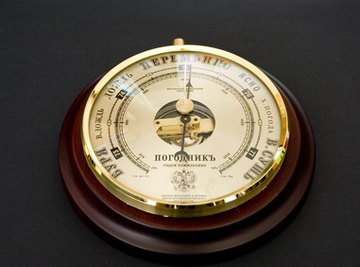
First developed by the Italian scientist Evangelista Torricelli in the 17th century, the barometer measures the atmospheric pressure, which helps meteorologists predict weather patterns. These slight changes in the atmosphere's pressure usually foreshadow changes in the weather. Barometers either use mercury or small metallic strips to show the changes in pressure. A mercury barometer, which is based on Toricelli's experiments, places a small amount of mercury in a vacuum. This mercury moves up or down depending on whether the atmospheric pressure weighs more or less than the mercury's own weight. Aneroid barometers, common in households, follow the expansion and retraction of two metallic strips as the atmospheric pressure changes.
Hygrometer
To test the humidity in the atmosphere, which helps forecast weather patterns, meteorologists use a hygrometer. Hygrometers use either a small metal coil, a liquid or a condensation to measure the humidity. When moisture touches the coil, it changes its physical shape. Condensation or "dew point" hygrometers measure the amount of condensation that appears on a small bulb. Finally, liquid hygrometers base their measurements on the chemical changes in the liquid due to the moisture in the air. A psychrometer, a fourth version of the hygrometer, uses thermodynamic properties by comparing a dry bulb and a bulb saturated with distilled water to measure the moisture. The Swiss physicist and geologist Horace Benedict de Saussure built the first hygrometer in 1783 and used a human hair as the coil.
References
Resources
About the Author
John Biles has worked as a freelance reporter for the "North Hills News Record" and a freelance theater critic for the "Cranberry Journal." Biles was a volunteer columnist at SteelCityInsider.com and Scout.com, a professional and independent source of news and information covering the Pittsburgh Steelers. He graduated from Point Park University with a Bachelor of Arts in journalism and mass communications.
Photo Credits
barometer image by pavel siamionov from Fotolia.com